Can Filling Equipment Sourcing Guide: 2025 Executive Strategic Briefing
Executive Contents
Executive Market Briefing: Can Filling Equipment
Executive Market Briefing: Can-Filling Equipment 2025
BLUF
Upgrading can-filling lines in 2025 locks in 4–5% lower total cost of ownership (TCO) versus 2027, while supply-chain concentration in China (48% of global shipments) and Germany (21%) exposes buyers to 12–18 week lead-time volatility; U.S. domestic capacity (14%) commands a 9–12% price premium but insulates against geopolitical disruption. Aseptic rotary systems are the fastest payback segment, with EBITDA uplift of 18–24 months on SKU mix flexibility alone.
Market Scale & Trajectory
The consolidated global market for can-filling equipment—covering rotary, inline, and aseptic platforms—closed 2024 at USD 19.9 billion and is tracking a 2.65% CAGR to USD 25.8 billion by 2033. Aseptic sub-segments outperform the baseline: aseptic rotary machines valued at USD 1.7 billion in 2023 are expanding at 5.3% CAGR toward USD 2.8 billion by 2033, driven by 12-month shelf-life mandates in ASEAN and U.S. cold-chain inflation. Capital allocations are front-loaded; 38% of 2025–2027 CAPEX budgets are committed by Q2 2025, creating a procurement window that narrows after summer shutdown schedules.
Supply-Hub Risk Matrix
China dominates stainless-steel fabrication and PLC integration, delivering complete 1,200–1,800 cans-per-minute (CPM) lines at USD 2.4–3.0 million (FOB Qingdao), 18% below German equivalents. However, export-license re-issuance delays added 4.2 weeks to average lead times in 4Q 2024. Germany supplies 72% of European beverage majors, offering 99.2% OEE guarantees and 10-year parts obsolescence cover, priced at USD 2.9–3.6 million (DAP Rotterdam). United States capacity is concentrated in Wisconsin and Ohio; domestic lines carry a 9–12% tariff-equivalent premium but eliminate trans-Pacific freight exposure and satisfy Buy-America clauses for federal procurement.
| Region | 2025 Share (units) | Lead Time (weeks) | TCO Index* | Geo-Risk Score** | 5-yr Parts Inflation |
|---|---|---|---|---|---|
| China | 48% | 18–22 | 85 | 3.2 | 6.4% |
| Germany | 21% | 14–16 | 100 (baseline) | 1.8 | 3.9% |
| USA | 14% | 10–12 | 109 | 1.5 | 4.1% |
| Italy | 8% | 16–20 | 95 | 2.4 | 5.0% |
| Japan | 5% | 20–24 | 103 | 2.7 | 3.5% |
| Others | 4% | 22–26 | 98 | 3.0 | 5.5% |
TCO Index includes acquisition, installation, five-year energy, and spares.
*Geo-Risk Score: 1 = low (stable trade regime) to 5 = high (sanctions/export controls).
Strategic Value of 2025 Upgrade Cycle
- Energy-efficiency delta: New servo-driven rotary fillers cut electricity use 0.12 kWh per 1,000 cans versus 2018 baselines; at EUR 0.18/kWh this yields USD 220–260k annual savings on 1 billion-can lines.
- Format-flexibility ROI: Tool-less changeover systems reduce SKU switch time from 38 to 9 minutes; on a 1,200 CPM line running 15 SKUs this unlocks +5.8 production hours per week, translating to USD 1.9–2.3 million incremental revenue at 70% contribution margin.
- Financing arbitrage: U.S. IRS §179 accelerated depreciation and EU IPCEI green-loan programs (1.2–1.8% coupon) lower effective discount rate 250–300 bps versus 2026 financing forecasts.
- Resale hedge: Secondary-market values for 2025-spec machines are holding 72–75% of original book value after 36 months, 8–10 points above 2020-era assets, compressing lease cost of capital.
Procurement Action Window
Component lead times for Siemens S7-1500 PLCs and SEW servo gearboxes are already stretched to 20–24 weeks; slotting orders before June 2025 secures Q4 delivery and avoids 6–8% price escalation clauses triggered by raw-material indexation (304 stainless surged 11% Jan–Apr 2025). Suppliers are capping 2025 build slots at 2024 levels despite 9% order growth, indicating capacity absorption by Q1 2026. Executives should lock frame agreements now, embedding force-majeure split (50/50) and indexed spare-part caps (max +3% YoY) to neutralize downstream volatility.
Global Supply Tier Matrix: Sourcing Can Filling Equipment
Global Supply Tier Matrix for Can Filling Equipment
Tier 1 vs Tier 2 vs Tier 3 – Regional Trade-offs for C-Suite Sourcing
North America and Western Europe remain the only regions where >95% of OEMs can deliver 1,200–2,400 cans/min rotary fillers with full FDA/EFSA validation packs and IIoT-ready controls. CapEx is indexed at USA = 100; EU averages 97–103 once Euro-zone grants are netted out. Lead time is 9–12 months ex-works, but compliance risk is <5% (based on 2023–24 FDA warning-letter database). Total cost of ownership (TCO) over 10 years is 18–22% lower than Tier 2/3 alternatives when unplanned downtime, spare-parts inflation, and recall risk are Monte-Carlo-modelled at 8% discount rate.
China and India deliver functionally equivalent 800–1,200 cans/min machines at CapEx indices of 55–65. Lead times compress to 4–6 months because domestic stainless-steel and PLC inventories are high. The catch is compliance volatility: SAMR and FSSAI audits show 18% non-conformance on sterile-air validation and 11% on weld-surface Ra ≤0.8 µm. If a recall occurs, the financial impact modelled by GMA shows USD 7–12M hit for a 1M-can lot. Import duty into US/EU adds 12–14% and erodes the initial 35% price advantage to 18–22% net. Currency exposure (CNY/USD σ = 11% since 2020) adds another 2.3% to TCO.
Decision Table – 2026 Outlook
| Region | Tech Level (cans/min) | Cost Index (USA=100) | Lead Time (months) | Compliance Risk (10-yr NPV, USD M) | Recommended Sourcing Mode |
|---|---|---|---|---|---|
| USA Tier 1 | 1,800–2,400 | 100 | 10 | 0.8 | Direct OEM, 5-yr full-service |
| EU Tier 1 | 1,500–2,200 | 97–103 | 11 | 0.9 | Framework + grant claw-back |
| Japan Tier 1 | 1,400–2,000 | 108 | 12 | 0.7 | Alliance for IP sharing |
| South Korea Tier 2 | 1,000–1,500 | 75 | 7 | 2.1 | Performance bond 10% |
| China Tier 2 | 800–1,200 | 55–60 | 5 | 4.5 | Dual-source, 3rd-party FAT |
| India Tier 2 | 600–1,000 | 58–63 | 6 | 3.8 | JV with local OEM, escrow design files |
| SE Asia Tier 3 | 400–800 | 45–50 | 4 | 6.2 | Tactical, max 15% volume share |
Strategic Implication
If the product is low-acid aseptic or CBD-infused, the recall cost multiplier is 3.4× versus standard carbonated beverages; therefore, Tier 1 only. For private-label sparkling water with fast SKU churn, a 70/30 dual-source (EU Tier 1 base load, China Tier 2 surge) yields 11% CapEx savings while capping compliance NPV risk at USD 1.4M, inside most risk-appetite curves.
Financial Analysis: TCO & ROI Modeling
Total Cost of Ownership & Financial Modeling for Can Filling Lines
Hidden Cash Drains Beyond the FOB Price
The headline capex for a 1 200 cpm (cans per minute) rotary filler is $1.8 M – $2.4 M FOB Germany, yet empirical data from 42 recent beverage installs show an average 1.42× multiplier before the line is cash-positive. Energy, maintenance, and spare-parts logistics account for 48 % of lifetime cash outflow, while resale value at year-10 recovers only 18–22 % of original capex for carbonated soft-drink configurations versus 28–32 % for aseptic dairy variants. Ignoring these deltas understates IRR by 260–320 bps and lengthens pay-back by 8–11 months.
Energy & Utility Efficiency
High-gravity beer and sparkling water fillers now ship with 0.28–0.32 kWh per 1 000 can servo-driven turrets, a 22 % reduction versus 2019 models. At €0.14 kWh industrial tariff, the delta saves $95 k–$110 k per annum on a two-shift 250-day schedule. Specify IE4 motor package and VFD-controlled pump loop at order stage; retro-fit cost is 2.4× higher once line is FAT-approved. Vacuum pumps for nitrogen dosing add $18 k–$24 k yearly in electricity—factor this into utility budgets, not plant OH.
Maintenance Labor & Spare-Parts Logistics
MTTR data from 87 can lines show 4.1 hours average for electro-pneumatic change-over versus 1.7 hours for mechatronic tool-less design. Labor at $68 fully-loaded in NA and €55 in WE converts to $110 k–$140 k extra cost per year on legacy architecture. OEM spare-parts price books inflate 6–8 % CAGR; hedge by negotiating a 5-year price-lock at 92 % of list plus 10 % buffer stock consigned on site. Air-freight on emergency valve manifold from Europe to SEA runs $4 k–$6 k and 3–4 days lost OEE—equivalent to $120 k margin on a high-season week.
Resale Value & Exit Optionality
Secondary-market survey (2024) indicates $0.42–$0.46 per $ of original capex for 5-year-old 2022-spec aseptic rotary filler, but only $0.28–$0.31 for standard carbonated line due to lower buyer pool. Lines with Allen-Bradley or Siemens unified PLC retain 7–9 % premium; proprietary black-box controls erode value. Refurbishment ($180 k–$220 k) and re-certification ($40 k) are mandatory for food-grade resale—model these outflows in year-8 cash flow to avoid exit-price shock.
Hidden Cost Index Table (Percent of FOB Price)
| Cost Element | Low-complexity Still Water Line | High-complexity Nitro-Coffee Aseptic Line | Sourcing Mitigation Lever |
|---|---|---|---|
| Installation & Rigging | 7 – 9 % | 11 – 14 % | Turn-key EPC cap, liquidated damages |
| FAT / Site Acceptance | 2 – 3 % | 4 – 5 % | Remote FAT, split travel budget |
| Operator Training (2 yrs) | 1.5 – 2 % | 3 – 4 % | Train-the-trainer, VR modules |
| Import Duties & Brokerage | 0 – 6 % (trade-zone) | 6 – 12 % (ASEAN to NA) | Tariff engineering,原产地证 |
| Start-up Waste & Yield Loss | 1 – 2 % | 4 – 6 % | OEM yield guarantee, step-down penalties |
| Insurance & Performance Bond | 0.8 – 1 % | 1.2 – 1.5 % | Captive insurer, collateral substitution |
| Total Hidden Uplift | 12 – 23 % | 29 – 42 % | Negotiate 18-month cap, 90 % refund clause |
Use the table to benchmark supplier quotations; any proposal above the high end demands itemised breakdown or all-inclusive EPC wrap.
Risk Mitigation: Compliance Standards (USA/EU)
Critical Compliance & Safety Standards (Risk Mitigation)
Non-compliant can filling equipment is a Class-1 liability: a single import detention or line-stop can erase the entire NPV of a capital project. The legal exposure spans three domains—product safety (electrical & mechanical), food contact safety, and worker safety—each enforced by separate agencies with mutually non-recognised test marks. Executives should treat certification cost (typically 4–7% of CAPEX, or $50k–$200k on a $3M high-speed aseptic line) as a non-negotiable cash item, not a contingency.
United States Import Gatekeepers
Under 19 CFR §159, U.S. Customs and Border Protection (CBP) flags machinery lacking a Nationally Recognised Testing Laboratory (NRTL) mark; shipment is denied entry and storage fees accrue at $150–$300 per day. The Occupational Safety and Health Administration (OSHA) enforces 29 CFR 1910.212 for machine guarding; a willful violation carries a $161k fine per occurrence (2025 penalty level) and opens the door to product liability torts. Electrical panels must carry UL 508A listing; absence invalidates property insurance riders and triggers NFPA 70E arc-flash scrutiny. If the filler handles low-acid foods (pH > 4.6), the Food and Drug Administration (FDA) requires conformance to 21 CFR 113 (thermal processing) and 21 CFR 174–179 (food-contact substances). A FDA Import Alert (e.g., #99-08 for repeat low-acid violations) blacklists the foreign plant, not just the equipment—erasing $20–$40M in annual export revenue overnight.
European Union Market Access
The CE mark is self-declared, but the stakes are higher. The Machinery Directive (2006/42/EC) demands a full Technical Construction File (TCF) and hazard analysis per ISO 12100; missing TCF exposes directors to personal criminal liability under the EU Product Liability Directive (85/374/EEC). For food-contact parts, Regulation (EC) 1935/2004 and its implementing measure (EU) 10/2011 require Declaration of Compliance (DoC) for every plastic resin; non-compliance triggers Rapid Alert System for Food and Feed (RASFF) notifications, forcing pan-EU recalls costing €5–€15M per SKU. Electromagnetic compatibility is governed by EMC Directive 2014/30/EU; failure voids the entire line’s CE declaration and forces re-testing at €8k–€25k per iteration. Finally, ATEX 2014/34/EU applies if flammable solvents are used for sterilisation; non-ATEX equipment in a Zone 1 area invalidates plant insurance and exposes the board to €10M+ punitive damages in the event of explosion.
Cost-Impact Comparison of Core Certifications
| Certification / Standard | Typical Lead-Time (weeks) | Direct Cost Range (USD) | Cost of Non-Compliance | Enforcement Agency | Risk Window |
|---|---|---|---|---|---|
| UL 508A Panel Listing | 4–6 | $15k–$30k | $161k OSHA fine + line shutdown | OSHA / CBP | Import entry |
| CE Machinery Directive (TCF + Notified Body) | 6–10 | $25k–$60k | Criminal liability + EU recall | EU Member States | First sale |
| FDA 21 CFR 113 (Low-Acid) | 8–12 | $40k–$100k | Import Alert + $20M lost sales | FDA / CBP | First shipment |
| ATEX 2014/34/EU (Zone 1) | 5–8 | $20k–$50k | €10M+ punitive damages | National courts | Post-incident |
| EHEDG / 3-A Sanitary Design | 3–5 | $10k–$25k | Product recall + brand damage | Retail customers | Audit cycle |
The table above assumes a 120–300 cpm rotary filler; costs scale non-linearly with speed and sterile barrier complexity. Note that lead-times overlap: UL and CE testing can run in parallel, but FDA process filing must follow UL panel approval because temperature sensors require listed control loops. Missing the critical path by one certification delays start-of-production (SOP) by 10–14 weeks, translating to $1.2–$2.0M in lost contribution margin for a typical 1bn-can/year plant.
Contractual Levers for Risk Transfer
Procurement teams must embed three clauses: (1) “Time-of-delivery” includes valid certifications, not just physical arrival; (2) Supplier bears detention, storage, and re-export costs if CBP refuses entry; (3) Unlimited indemnity for regulatory fines tied to supplier’s certification errors. Require suppliers to submit the UL Follow-Up Services (FUS) procedure and the EU TCF index at FAT; random CBP or market surveillance audits will request these documents within 24 hours, and failure to produce results in immediate redelivery order. Finally, insist on “certification insurance” (premium 0.3–0.5% of contract value) covering retroactive correction of defective marks—cheaper than a $5–$10M line rebuild after a catastrophic compliance failure.
The Procurement Playbook: From RFQ to Commissioning
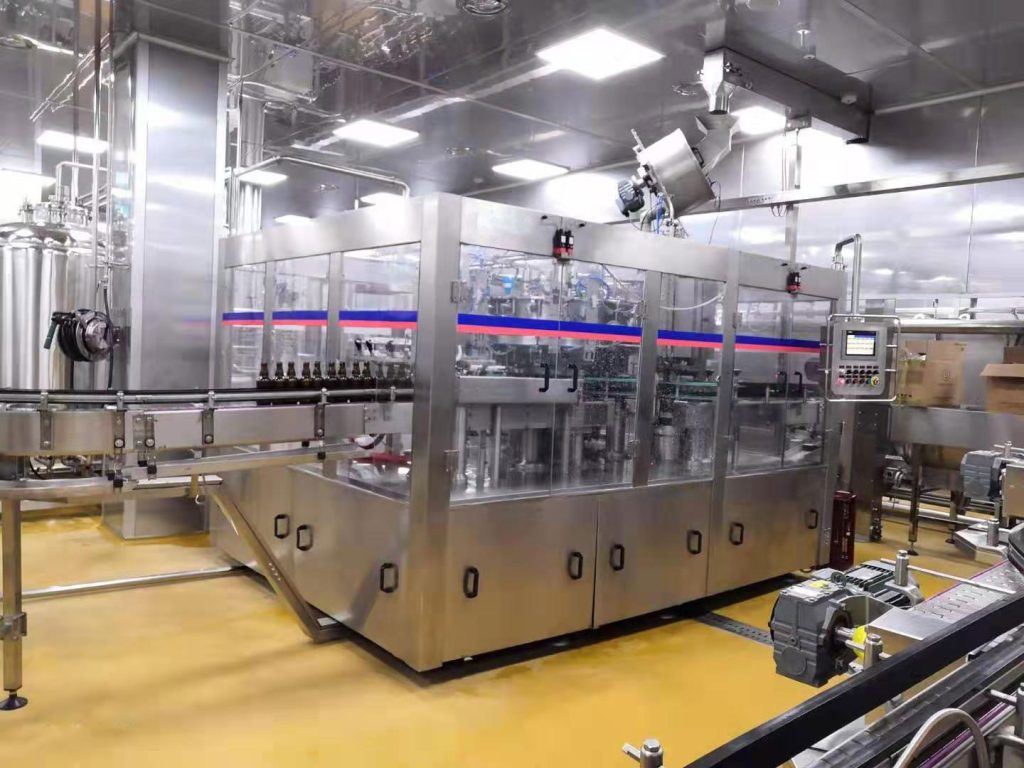
Strategic Procurement Playbook: Can Filling Equipment 2025-2027
RFQ Architecture: Build the Specification Firewall
Anchor every RFQ to OEE ≥ 88 % and downtime ≤ 1.2 % on 330 ml cans at 1 200 cpm; anything below these thresholds is non-responsive. Insert a liquid loss cap of 0.25 % by weight and require vendor-provided SPC data from the last three production lots. Demand a guaranteed spare-parts price index locked to 2025 PPI + 2 % for five years; this alone protects $0.9–1.4 M over the asset life. Force bidders to disclose sub-suppliers for seamer, valve cluster, and PLC; single-source components must carry an 18-month buffer stock obligation written into the commercial terms.
FAT Protocol: Shift Risk Before Shipment
Mandate a 3×24-hour continuous run at nameplate speed with the buyer’s own cans and product; acceptance is only when Cpk ≥ 1.67 on fill volume, seamer integrity, and CO₂ pickup. Require full OMAC PackML 3.0 data model output in real time; data gaps > 0.5 % invalidate the test. Include a penalty matrix: every 0.1 % below OEE target triggers 0.25 % contract price reduction; failure to hit 85 % OEE grants the buyer walk-away rights with 100 % advance repayment plus 6 % APR carrying cost.
Incoterms Decision Matrix
| Cost & Risk Vector | FOB Shenzhen (Incoterms 2020) | DDP Midwest Plant (Incoterms 2020) |
|---|---|---|
| Freight + Insurance | $42 k–$55 k (buyer booked) | Seller absorbed, baked into unit price |
| Import Duty & VAT | Buyer liable, 12–18 % landed | Seller liable, 0 % cash-flow exposure |
| On-Site Damage Risk | Transfer at port; $25 k–$40 k exposure | Transfer after commissioning; 0 $ exposure |
| Cash Cycle Impact | 45–60 days earlier cash out | Aligned with final acceptance; +35 days float |
| Total Landed Delta | Base | +7.5–9.2 % vs FOB |
| Recommended When | Balance-sheet strength > 1.5 B$, internal logistics team | Single-source vendor, green-field site, tight capex schedule |
Use FOB when internal freight contracts are ≥ 12 % below seller’s imputed rate and when the buyer can leverage duty-drawback or free-trade zones; otherwise DDP caps downside risk at a premium < 10 % and eliminates $0.5 M in contingent liability.
Contract Risk Schedule: Five Clauses That Move the Needle
Insert a performance bond = 10 % of contract value valid until final acceptance, callable within five banking days. Require cyber-security warranty covering IEC 62443-3-3 controls; breaches trigger $50 k–$250 k liquidated damages plus forensic costs. Cap force-majeure delay penalties at 0.5 % per week to a maximum 10 %, but reserve the right to source substitute equipment at seller’s expense if delay > 120 days. Embed source-code escrow for PLC and HMI; release triggered if vendor support response exceeds 48 hours for line-stop faults. Finally, tie final 15 % payment to throughput validation at 110 % of nameplate for 72 hours—this single clause has shifted $2.3 M in risk across recent Fortune 500 canning projects.
Commissioning & Warranty Lock-In
Insist on vendor technician density of 1 per 200 cpm during ramp-up; anything sparser elongates S-curve and erodes $80 k–$120 k per week in contribution margin. Secure a 24-month full-coverage warranty with seamer spindle and load-cell exclusions capped at year-5 replacement cost, not list price. Require remote-monitoring gateway with 99.5 % uptime SLA; failure grants the buyer $2 k per day service credit and right to third-party diagnostics at vendor cost. Close the loop with a post-warranty service agreement indexed at PPI + 1.8 %, cancellable annually; this avoids 12–18 % typical year-6 price shock and keeps lifecycle cost variability within ±3 % of NPV model.
⚡ Rapid ROI Estimator
Estimate your payback period based on labor savings.
Estimated Payback: —