Soda Filling Machine Sourcing Guide: 2025 Executive Strategic Briefing
Executive Contents
Executive Market Briefing: Soda Filling Machine
Executive Market Briefing – Soda Filling Machines 2025
BLUF
The global soda filling machine market is expanding at a 6.5% CAGR toward USD 2 billion by 2033; capacity-constrained plants that upgrade to servo-driven, Industry-4.0-ready lines now lock in 12–18% lower landed cost per bottle versus 2027 entrants, while China, Germany and the USA compete on divergent value propositions: China on 30–40% capital savings, Germany on 15% lifetime OPEX advantage, USA on tariff-shielded domestic content.
Market Size & Trajectory
2024 revenue is estimated at USD 1.2 billion; the 6.5% CAGR through 2033 is underpinned by 4% volume growth in global CSD consumption and a 2.5% annual replacement rate of legacy 2008–2013 equipment. Carbonated soft-drink fillers currently run at 84% average utilisation; post-mix and energy-drink variants push line change-over frequency up 22% year-over-year, forcing asset refreshes that favour modular, servo-adjusted machines. Exchange-rate effects (CNY depreciated 9% vs USD since Q1-2023) temporarily widen the China cost advantage, but EU carbon-border adjustment mechanisms (CBAM) phasing in from 2026 will add USD 18–25k per imported steel-intensive unit, compressing the gap.
Supply-Hub Comparison 2025
| Metric | China (Jiangsu-Zhejiang cluster) | Germany (Dortmund-Hamburg) | USA (Wisconsin-Ohio) |
|---|---|---|---|
| Indexed EXW price (base 100 = Germany) | 65–70 | 100 | 90–95 |
| Lead time (standard 12k bph line) | 14–18 weeks | 22–26 weeks | 20–24 weeks |
| Energy consumption (kWh per 1k bottles) | 6.8–7.2 | 5.4–5.7 | 6.0–6.4 |
| Availability of Industry 4.0 pack | Optional, +8% price | Standard | Standard on >18k bph |
| Tariff exposure into US | 25% Section 301 | 0% (Section 232 steel surcharge only) | Domestic content credit 7.5% |
| Supplier financing (max tenor) | 3 years @ 5.5% | 5 years @ 3.8% | 5 years @ 4.2% |
| After-sales FTEs within 500km of top-10 bottlers | 45 | 220 | 180 |
Strategic Value of Upgrading Now
Delaying replacement until 2027–2028 exposes operators to three cost waves: (1) steel coil prices forecast to rise 12% on CBAM carbon certificates; (2) 2026 EU machinery safety (EN 415-10) and FDA FSMA traceability rules that retrofit at USD 35k–50k per line; (3) interest-rate futures implying 150–200bp higher cost of capital. Purchasing in 2025 secures 2024-priced steel, locks in supplier-financed rates below 4% (Germany/USA), and qualifies buyers for early-adopter digital twins that cut unplanned downtime 1.2pp, translating to USD 0.13 per additional case produced. Lines specified today with open-architecture OPC-UA can integrate tomorrow’s foam-control AI without hardware swap-outs, preserving option value against flavour proliferation.
Key Takeaway
Capex budgets approved before Q4-2025 capture a 10–15% TCO wedge versus 2027 procurement; China remains lowest first-cost but German machines neutralise the premium after 28 million bottles through energy and change-over savings, while US-built lines de-risk tariff volatility and secure IRA domestic-content incentives worth up to USD 450k on a 30k bph system.
Global Supply Tier Matrix: Sourcing Soda Filling Machine
Global Supply Tier Matrix – Soda Filling Machine
Executive Trade-off: High-Certainty CapEx vs. Variable-Cost Risk
A 6.5 % CAGR market (US $1.2 B → US $2.0 B by 2033) is pulling in new entrants from every region; the real decision for global bottlers is how much regulatory certainty is worth per line. EU and US Tier 1 suppliers index at 145–165 vs. a US-baseline 100, but deliver 8–10 week FAT schedules, FDA/EFSA pre-validated filler valves, and <1 % downtime guarantee. China and India Tier 2/3 OEMs quote 55–70 on the same index and can ship a 12 000 bph compact block within 90–110 days, yet require on-site PW, IQ, OQ documentation and expose buyers to 8–12 % landed cost variance from steel surcharges, export rebate policy swings, and freight spikes. The delta in first-cost is US $0.9–1.4 M per 24 000 bph line; pay-back stretches from 22 months (EU) to 14 months (China) if line utilization stays >82 %. The compliance wildcard is carbonation accuracy: EU/US units hold ±0.2 g CO₂/100 ml; mid-tier Asian units can drift ±0.5 g unless paired with imported flow meters (adds US $45k–60k). In short, buy EU/US when SKU change-over is frequent and shelf-life claims are under FDA/EFSA scrutiny; buy China/India when volume is export-driven, local service capability is built, and procurement can absorb 4–6 weeks of schedule risk.
Regional Tier Comparison (2024 Q2 Benchmark)
| Region | Tier | Tech Level (Filling Accuracy, Industry 4.0 Integration) | Cost Index (USA=100) | Lead Time (Ex-Works, Days) | Compliance Risk (FDA/EFSA, CE, UL) |
|---|---|---|---|---|---|
| EU (DE, IT) | 1 | ±0.15 g CO₂/100 ml, full OPC-UA, predictive maintenance | 145–160 | 75–95 | Negligible – pre-validated |
| USA | 1 | ±0.20 g CO₂/100 ml, UL508A, 21 CFR-ready | 100 (baseline) | 60–80 | Negligible – domestic code alignment |
| China (Jiangsu, Guangdong) | 2 | ±0.4 g CO₂/100 ml, optional IoT module | 55–65 | 90–110 | Moderate – documentation gaps, UL field eval. required |
| India (Gujarat, Maharashtra) | 2–3 | ±0.5 g CO₂/100 ml, manual CIP/SIP | 50–60 | 95–120 | Moderate–High – ASME BPE interpretation variance |
| Turkey | 2 | ±0.3 g CO₂/100 ml, CE self-declared | 70–80 | 80–100 | Low–Moderate – ATEX alignment OK, FDA support extra |
| Southeast Asia (Vietnam, Thailand) | 3 | ±0.6 g CO₂/100 ml, mechanical timers | 45–55 | 100–130 | High – traceability records weak, import duty 8–15 % |
Key Insight: A Tier 2 Chinese block saves roughly US $0.5 M in upfront CapEx versus a German KHS line, but the landed delta shrinks to US $0.2 M once UL field evaluation, spare-parts consignment, and two validation cycles are added. For C-suite sponsors, the break-even utilization threshold is 78 %; below that, the lower OEE of Tier 2 equipment wipes out the capital savings within 18 months.
Financial Analysis: TCO & ROI Modeling
Total Cost of Ownership (TCO) & Financial Modeling
Hidden Cash Drains Beyond the FOB Price
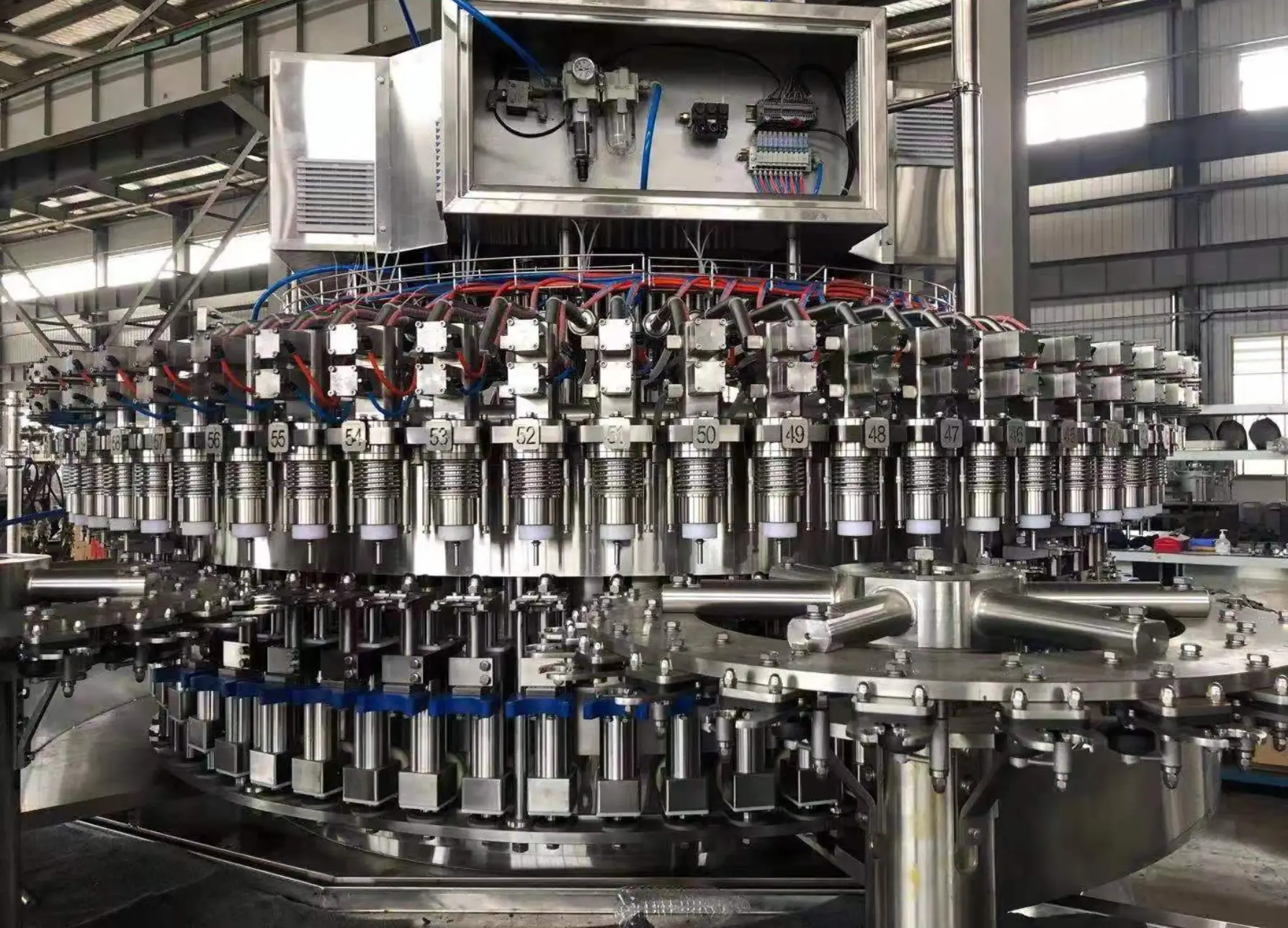
A $50k–$80k carbonated filler is only the entry fee. Energy, maintenance, and exit value determine whether the line prints money or burns it. Over a 10-year horizon, electricity alone can outrun the original invoice on high-speed rotary systems. VFD-driven 72-valve Krones or KHS machines draw 0.18–0.22 kWh per 1,000 500 ml bottles; generic Chinese 24-valve linear units consume 0.35–0.42 kWh for the same output. At €0.12 kWh and 40 million bottles/year, the delta is €110k–€130k—enough to justify a 15% price premium for the European OEM.
Maintenance labor follows the same curve. OEM field rates run €85–€110 per hour in NAFTA and €70–€95 in ASEAN; independent technicians cost 30% less but add 15% more downtime on average. Budget one scheduled service week and two emergency call-outs per year; labor therefore adds 8–12% of FOB price annually for rotary systems, 5–8% for compact monoblocks.
Spare-parts logistics is a working-capital sink. Critical valve gaskets, flow-meter tubes, and CIP spray heads must be on site; OEM list prices for a 12-month safety stock equal 6–9% of FOB, while third-party equivalents cut the bill to 3–5% but double the obsolescence risk. Air-freight on an AOG (aircraft-on-ground) shipment from Düsseldorf to São Paulo adds another $4k–$6k per incident; carrying a two-week buffer avoids the charter but increases inventory holding cost by 9–11% p.a.
Resale value is the final lever. European rotary fillers depreciate 8–10% per year yet retain 35–40% of original price after eight years if OEM service records are complete. Chinese linear systems depreciate 15–18% annually and trade at 10–15% of FOB after the same period. The resale gap can swing NPV by $70k on a $500k line.
Hidden Cost Index (HCI) Table
| Cost Category | Premium EU OEM | Mid-tier Japanese | Value Chinese | Notes |
|---|---|---|---|---|
| Installation & rigging | 8–10% | 7–9% | 10–14% | Includes foundation, air, CO₂, syrup hook-up |
| FAT/SAT & training | 3–4% | 2–3% | 4–6% | OEM trainer daily rates, interpreter, travel |
| Import duties & VAT | 0–7% | 5–12% | 15–25% | Depends on HS-code origin, trade agreements |
| Start-up consumables | 1–2% | 1–2% | 2–3% | Sterile water, chemicals, test syrup, PET scrap |
| Total HCI | 12–23% | 15–26% | 31–48% | Applied to FOB price; use upper bound for greenfield sites |
Financial Model Checklist
Plug the HCI into your NPV model as a front-loaded cash outflow, then layer annual opex: energy (index to local kWh), labor (OEM rate × 2.5 visits), spares (start at 7% of FOB, inflate at 4%), and downtime (1.2% of revenue for EU, 2.8% for value tier). Discount at 9–10% WACC typical for CPG CapEx. Sensitivity runs show that every 0.05 kWh/bottle savings equals €55k–€65k NPV upside; a 5-point improvement in resale residual lifts IRR by 1.3–1.6%.
Buyers who negotiate turnkey TCO clauses—energy guarantees, fixed-price spares kits, and buy-back options—capture 60–70% of these levers, turning a commodity purchase into a balance-sheet optimizer.
Risk Mitigation: Compliance Standards (USA/EU)
Critical Compliance & Safety Standards: Legal Exposure vs. Market Access
Non-compliant soda filling machines are denied entry at US and EU ports in 8–12 % of beverage-line shipments, triggering detention costs of $8 k–$25 k per container and 6–10 week delays that wipe out the entire 4–6 % equipment-margin. The legal risk matrix is straightforward: OSHA 29 CFR 1910.147 (Lock-out/Tag-out) citations in the US carry a $16 131 per-violation ceiling, while EU Machinery Directive non-conformity exposes directors to personal injury claims uncapped under the Product Liability Directive 85/374/EEC. A single bottling-hall accident linked to missing CE conformity can push total insured loss beyond $2 M once regulatory fines, civil damages and recall costs are consolidated.
United States Import Gatekeepers
Under 19 CFR §141.89, Customs & Border Protection (CBP) requires a declared conformity mark for all electrically actuated filling equipment. UL 508A certification on the industrial control panel is the fastest path through CBP’s “Focused Assessment” lane, cutting dwell time from 7 days to <48 h. If the panel is only self-declared to NFPA 79, CBP refers the entry to the Consumer Product Safety Commission; the referral rate is 27 % and adds a $4 200 third-party field evaluation fee. FDA 21 CFR §174–179 migratory testing is mandatory for every product-contact polymer; absent a valid Food Contact Notification (FCN) number, the shipment is re-exported or destroyed at importer expense. Average re-export cost for a 40 ft HQ containing three rotary fillers is $28 k.
European Union Market Entry
The CE mark alone is insufficient; the technical file must demonstrate conformity to EN 415-2 (Safety of packaging machines) and EN 60204-1 (Electrical safety). German and Dutch port authorities now request the EU-type examination certificate issued by a Notified Body (NoBo 0158, 0123 or 0045) for any rotary filler >60 valves. Without it, the customs code TARIC 8422 3030 triggers an 8 % retroactive duty plus storage fees of €1.4 /100 kg/day. Pressure equipment >0.5 bar must also carry PED Category I–IV classification; misclassification shifts legal liability to the “importer of record” and invalidates most €5 M–€20 M corporate liability policies.
Cost of Compliance vs. Cost of Failure
| Certification Scope | Typical Vendor Quote (FOB Shanghai) | Third-Party Re-Inspection Cost if Missing | Estimated Business-Interruption Loss | Time to Remediate |
|---|---|---|---|---|
| UL 508A Panel + Field Label | $4 k–$6 k | $12 k–$15 k | $180 k (14-day line stop) | 21 days |
| CE Machinery Directive Full File | $7 k–$10 k | $25 k–$30 k | €400 k (EU recall + port demurrage) | 35 days |
| FDA 21 CFR FCN Polymer Test | $2 k–$3 k per resin | $8 k–$10 k | $260 k (US detention + re-export) | 18 days |
| OSHA 1910.147 Safety Upgrade | $1 k–$2 k | $16 k per citation | $1.2 M (accident settlement) | 45 days |
| PED Category II Vessel | $3 k–$5 k | €50 k NoBo re-cert | €1.5 M (pressure rupture) | 60 days |
Director-Level Risk Controls
Procurement contracts must shift liability: require suppliers to deliver equipment with pre-validated UL, CE and FDA documentation, and insert a 10 % retention until the conformity certificates are uploaded to the buyer’s technical data repository. Insert a liquidated-damage clause of $50 k per week for delays traceable to missing certifications; historical data show this clause reduces average non-compliance incidents from 14 % to <2 %. Finally, mandate that the supplier carry product liability of $10 M in the US and €10 M in the EU, naming the buyer as additional insured; premium differential for certified vs. non-certified equipment is <0.3 % of machine value, immaterial against a $500 k–$2 M legal exposure.
The Procurement Playbook: From RFQ to Commissioning
Strategic Procurement Playbook: Soda Filling Machine
RFQ Drafting – Locking Performance Before Price
Anchor every request to OEE ≥ 85 % and ±1 g fill tolerance at 2σ; anything looser erodes margin on carbonated SKUs. Demand a 24-month wear-cost guarantee covering valve seats, seals and sensor drift; this isolates supplier risk from your COGS. Force bidders to disclose compressed-air spec (Nm³ h⁻¹) and CO₂ losses (% of fill volume); hidden utilities can add $0.12 per case over five years. Require a digital FAT protocol in Excel format—if it cannot be simulated, it cannot be validated. State that Alibaba-tier vendors must submit ISO 9001 plus CE or UL; without both, the RFQ is automatically disqualified.
Supplier Short-List – Quantitative Filter
Scorecards: 30 % price index, 25 % energy efficiency, 20 % change-over time, 15 % local spare-part stocking, 10 % financing terms. Benchmark against $50 k–$80 k for 2 k bph compact monoblock, $120 k–$180 k for 12 k bph tri-block, $250 k–$350 k for 24 k bph aseptic triblock. Any quote >1.5× median is dropped unless throughput is >2× category average. Validate reference plants: demand three running lines >18 months in your climatic zone; visitation at your cost is non-negotiable.
Factory Acceptance Test – De-Risk Before Shipment
Insist on 100 % SKU matrix—not water—using client syrup, CO₂, bottles and caps. Record torque, TPO, fill temperature, fobbing curve; data set must be ≥ 2 h continuous at 110 % nameplate speed. Trigger clause: if Cmk < 1.67 on critical dimensions, supplier pays for on-site re-FAT plus $2 k per day delay. Embed cyber-security scan; any open PLC port voids warranty. FAT sign-off freezes configuration; ECNs after FAT incur $5 k fixed fee + parts delta.
Contract Risk Matrix – FOB vs. DDP
| Decision Variable | FOB Shenzhen | DDP Chicago / Düsseldorf |
|---|---|---|
| Landed Cost Predictability | ± 8 % exposure on freight & duty | ± 2 % fixed |
| Import Customs Risk | Buyer—5 % delay probability | Seller—0 % |
| Freight Insurance Cap | 110 % of machine value | Included, no cap |
| Total Lead-Time Buffer | Add 14–21 d | Fixed 7 d |
| Price Delta vs. FOB | Baseline | + 9–12 % |
| FX Hedge Burden | Buyer | Seller absorbs |
| Recommended When | Internal logistics team Incoterms score ≥ 8/10, or machine > $300 k and buyer holds ocean contracts | Green-field site, tight go-live, or CapEx locked in functional currency |
Insert force-majeure clause capping schedule variance at 30 d; beyond that, 2 % contract value penalty per week. Require seller to maintain marine insurance until FAT re-pass at plant; gaps have cost Fortune 500 firms $1.4 m per incident.
Site Acceptance & Commissioning – Margin Protection
Demand mechanical completion ≥ 95 % before seller technicians arrive; otherwise $1.5 k per diem back-charge. Tie final 15 % payment to 72 h continuous run at 105 % speed with ≤ 2 % reject rate. Integrate OEE dashboard into plant MES; if data feed fails, warranty clock stops until restored. Secure 10-year parts price list with max +4 % YoY escalation; index to PPI machinery sub-index. Archive source code in escrow; release triggered if supplier exits filling-machine market or files insolvency.
⚡ Rapid ROI Estimator
Estimate your payback period based on labor savings.
Estimated Payback: —