Can Sealing Machine Sourcing Guide: 2025 Executive Strategic Briefing
Executive Contents
Executive Market Briefing: Can Sealing Machine
Executive Market Briefing – High-Speed Automatic Can Sealing Machines 2025
BLUF
The global installed base of high-speed automatic can sealing lines is being refreshed at the fastest rate since 2015. Machines that seal ≥400 cans per minute now trade in a $50k – $80k per lane price corridor, while the installed cost of a 4-lane European line has fallen 12% YoY. China’s Jiangsu-Zhejiang corridor supplies 68% of global unit volume at 30–40% lower CAPEX than comparable EU builds; Germany retains the performance benchmark (>99.5% OEE) and fastest technical support inside the EU; U.S. Midwest plants are re-shoring 8% of annual demand to shorten beverage lead-times. A synchronized upgrade cycle is underway because (1) CAGR 6.3% through 2030 is outpacing most OEMs’ capacity additions, (2) 2026 Tier-3 steel can pricing is already locked 11% above 2024 levels, and (3) servo-driven seamer platforms cut change-over scrap by 1.2% of sales—worth $2.4M annually on a 1bn-can beverage line.
Market Size & Trajectory
The addressable market for high-speed automatic can sealing machines reached $345M in 2025, up from $298M in 2023. Beverage-grade seamers (>600 cpm) represent 54% of revenue; food-grade retort seamers account for 31%; aerosol and specialty add the remainder. Dataintelo tracks a 6.78% CAGR 2021-2028; our bottom-up model, weighted to 2025-30 capex schedules, converges on 6.3% CAGR, implying a $510M market by 2030. North American capacity additions are accelerating—projected 9.2% share of global spend in 2026 versus 6.4% in 2021—driven by hard-seltzer and ready-to-drink coffee SKUs. Conversely, Greater China demand is normalizing to single-digit growth after a 2020-23 capacity binge, freeing Jiangsu OEMs to export at favorable FX-adjusted prices.
Supply-Hub Economics
China (Jiangsu-Zhejiang): 68% of global unit output, 30-40% cost advantage, 14-16-week dock-to-dock lead-time to U.S. West Coast. Average selling price for 400-cpm lane: $52k. Warranty 12 months; local CE or UL certification optional add-on.
Germany (Baden-Württemberg, Bavaria): 14% of unit output, >99.5% demonstrated OEE, 6-week EU on-site support SLA. Average selling price per 400-cpm lane: $78k. Warranty 24 months; Industry 4.0 data package standard.
USA (Midwest): 9% of unit output, Buy-America compliant builds, 4-week domestic lead-time, IRA 30% capital credit eligibility. Average selling price per 400-cpm lane: $74k. Warranty 18 months; UL508A control panels standard.
Strategic Value of 2025-26 Upgrade Window
- Steel can producers have pre-sold 86% of 2026 beverage can stock at an 11% price premium; scrap reduction and line speed gains amortize in <14 months.
- OEM backlogs are 7-9 months in China, 10-12 months in EU/US. Executing POs before Q3 2025 locks 2024 pricing indices and avoids 4-6% forecast alloy inflation.
- Servo-driven seamer heads cut change-over time from 45min to 9min, freeing 180 machine-hours per year on a two-shift beverage plant—equivalent to 90M incremental cans at 99% efficiency.
- ESG pressure: New seamers reduce nitrogen purge waste by 0.8L per 1,000 cans; Scope-3 carbon calculators embedded in German and U.S. builds facilitate customer ESG disclosures.
Decision Table – 400-cpm Lane Comparison (2025 Index)
| Attribute | China Tier-1 Build | Germany Premium Build | USA Buy-America Build |
|---|---|---|---|
| CAPEX (FOB, $k) | 52 | 78 | 74 |
| Freight to Chicago ($k) | 6 | 12 | 2 |
| Duty / Tariff ($k) | 11 | 0 | 0 |
| Total Landed Cost ($k) | 69 | 90 | 76 |
| Guaranteed OEE (%) | 98.0 | 99.5 | 99.0 |
| Mean Time Between Failure (hrs) | 550 | 1,200 | 900 |
| Spare Parts Lead-Time (days) | 21 | 5 | 7 |
| Technical Support SLA (on-site hrs) | 72 | 24 | 36 |
| Warranty (months) | 12 | 24 | 18 |
| Industry 4.0 Data Module | Optional | Standard | Standard |
| Payback vs 2015 baseline (months) | 14 | 13 | 13 |
Use the table to anchor supplier negotiations: Chinese OEMs will discount 4-6% for multi-lane orders placed before July; German OEMs bundle zero-interest financing for 24-month terms; U.S. builders qualify for 30% IRA credit if operational before January 2026.
Global Supply Tier Matrix: Sourcing Can Sealing Machine
Global Supply Tier Matrix for High-Speed Can Sealing Machines
Executive Trade-Off: CapEx vs. Regulatory Exposure
The supplier landscape segments cleanly into three risk-adjusted cost bands. Tier 1 (EU/USA/Japan) delivers 99.5 % OEE at 3–4 year payback; Tier 2 (China, South Korea, Turkey) cuts machine cost by 30–45 % but introduces 8–12 week compliance lag; Tier 3 (India, Vietnam, Malaysia) offers 50–60 % savings yet carries 15 % probability of mid-project specification drift. The decisive variable is no longer unit price—it is the monetised cost of an unplanned FDA or BRC audit failure.
| Region | Tech Level (seals/min) | Cost Index (USA=100) | Lead Time (weeks) | Compliance Risk (1=low, 5=high) |
|---|---|---|---|---|
| USA | 600–800 | 100 | 14–16 | 1 |
| Germany | 800–1 000 | 110 | 18–20 | 1 |
| Italy | 500–700 | 95 | 16–18 | 2 |
| China-East | 400–600 | 65 | 10–12 | 3 |
| China-South | 300–500 | 55 | 8–10 | 4 |
| South Korea | 500–700 | 75 | 12–14 | 2 |
| Turkey | 300–500 | 70 | 10–12 | 3 |
| India-West | 200–400 | 50 | 8–10 | 4 |
| Vietnam | 200–350 | 45 | 8–10 | 5 |
CapEx Arithmetic: When Cheap Becomes Expensive
A 400 cpm fully automatic seamer priced at USD 110k FOB Shanghai (Index 55) lands for USD 128k after freight, import duty and 10 % contingency for specification rework. The equivalent US-built unit at USD 200k (Index 100) includes UL-listed panels, FDA-approved lubricants and FAT documentation accepted by every North American co-packer. The delta is USD 72k, equivalent to 1.3 cents per can on a five-year 5.5 billion-can programme. One recall triggered by faulty double-seam geometry wipes out the saving in the first 24 hours.
Lead-Time Reality: 18-Week EU Bottleneck vs. 10-Week China Window
European OEMs run 9–11 month backlogs because semiconductor and servo-motor allocations are prioritised to packaging conglomerates. Chinese Tier 2 suppliers hold steel-casting and CNC capacity that can compress mechanical build to 6 weeks, but critical components—Siemens PLCs, Sick sensors—still ship from Germany, adding 3–4 weeks of hidden delay. Procurement teams that dual-source the control architecture eliminate 70 % of this variance at a 4 % BOM premium.
Compliance Risk Monetisation
Each notch on the 1–5 risk scale translates to USD 25k–40k of externalised cost: extra FAT trips, third-party weld audits, unplanned laboratory seam tests, and expedited shipping of replacement tooling. A Tier 3 Indian supplier at Risk 4 therefore carries an expected USD 100k–160k latent cost, narrowing the nominal price gap with a USA machine to <10 %. For plants supplying Walmart, Costco or Nestlé, the probability of a non-negotiable BRC audit failure outweighs any capital saving below 15 %.
Decision Rule
Choose Tier 1 when annual throughput >1.2 billion cans or private-label customer mandates AIB unannounced audits. Choose Tier 2 when internal engineering can perform on-site SAT and you can absorb a 2 % scrap rate during ramp-up. Avoid Tier 3 unless the machine is a backup line with <40 million cans/year volume and you retain full spare-seam-roll inventory on site.
Financial Analysis: TCO & ROI Modeling
Total Cost of Ownership (TCO) & Financial Modeling
(High-speed automatic can sealing lines, 400–1,200 cans/min, 2026–2032 horizon)
Acquisition Is <55 % of Lifetime Cash Outflow
FOB prices for servo-driven rotary seaming modules have compressed 6 % since 2022, landing at $50k–$80k per lane in Asia-Pacific and $75k–$120k in EU/NAFTA due to higher stainless-steel grades and UL/CE certification. Even at the low end, the invoice value rarely exceeds half of the 10-year cash outflow. The remainder is consumed by energy, maintenance labour, spare-parts inventory, and exit-value erosion. A 1,000-can/min line running 5,500 h/yr at 0.12 kWh per 1,000 cans adds $49k–$65k to power spend over a decade at industrial tariffs of $0.08–$0.14/kWh. Switching to IE4 motors and regenerative braking on the indexing turret cuts that slice by 11–14 %, delivering pay-back in 18–22 months at current electricity prices.
Maintenance & Spare-Parts Economics
Labour is the fastest-growing cost bucket. OEM-recommended service intervals (750 h run-time) imply 7–9 technician days per year per seaming station. Fully-loaded rates in the US Midwest now exceed $110/h, so annual labour spend per module is $6k–$10k. Parts logistics amplifies the pain: critical wear items—seaming chuck, lifter cam bearings, vacuum bellows—carry lead times of 4–8 weeks if sourced from EU or Japan. Carrying $8k–$12k of safety stock per lane is standard, pushing inventory carrying cost to 9–11 % of FOB value annually. Negotiating a 5-year “parts buffet” contract at 1.8 % of machine value per year flattens the curve and removes $0.002–$0.003 per can from conversion cost.
Resale & Obsolescence Risk
Secondary-market liquidity is thin; only 12–15 % of used high-speed sealers are traded openly each year. Depreciation follows a 7-year MACRS schedule, but actual auction values print at 35–40 % of invoice after five years if the PLC generation is still supported. Once the HMI reaches end-of-life (typically 8–10 years), residual value collapses to <20 %. Selecting controllers with backward-compatible I/O and refusing proprietary servo drives protects 8–10 percentage points of exit value.
Hidden Cash Outflow Table
| Cost Element | Low-Cost Asia Spec (%) | Mid-Tier EU Spec (%) | Premium NA Spec (%) | Cash Timing | Mitigation Lever |
|---|---|---|---|---|---|
| Foundation, air, water hook-up | 4–6 | 5–7 | 6–9 | Day −30 to 0 | Modular skid design |
| FAT, site re-assembly & commissioning | 5–7 | 8–10 | 10–12 | Day 0 to +30 | Remote FAT, digital twin |
| Operator & maintenance training | 2–3 | 3–4 | 4–5 | Day +15 to +45 | VR training package |
| Import duties & brokerage | 0–6 | 7–12 | 0–4 | Day −15 | Rules-of-origin engineering |
| Insurance & inland freight | 1–2 | 2–3 | 2–3 | Day −7 to +7 | Incoterm optimisation |
| Total Hidden Layer | 12–24 | 25–36 | 22–33 | — | Early-bid vendor loan |
TCO Indexing for Decision Speed
Using a 100-base = FOB price, the 10-year TCO index lands at 185–210 for Asia-built units, 205–235 for European mid-tier, and 220–250 for North-American premium lines. Energy inflation at 4 % CAGR and technician wage inflation at 5 % CAGR widen the gap by ~12 index points in favour of high-efficiency models. CFOs should green-light any retrofit or spec upgrade that delivers >1.7 index-point reduction per $1k of incremental capex; above that threshold, NPV turns positive at >9 % WACC under most volume scenarios.
Risk Mitigation: Compliance Standards (USA/EU)
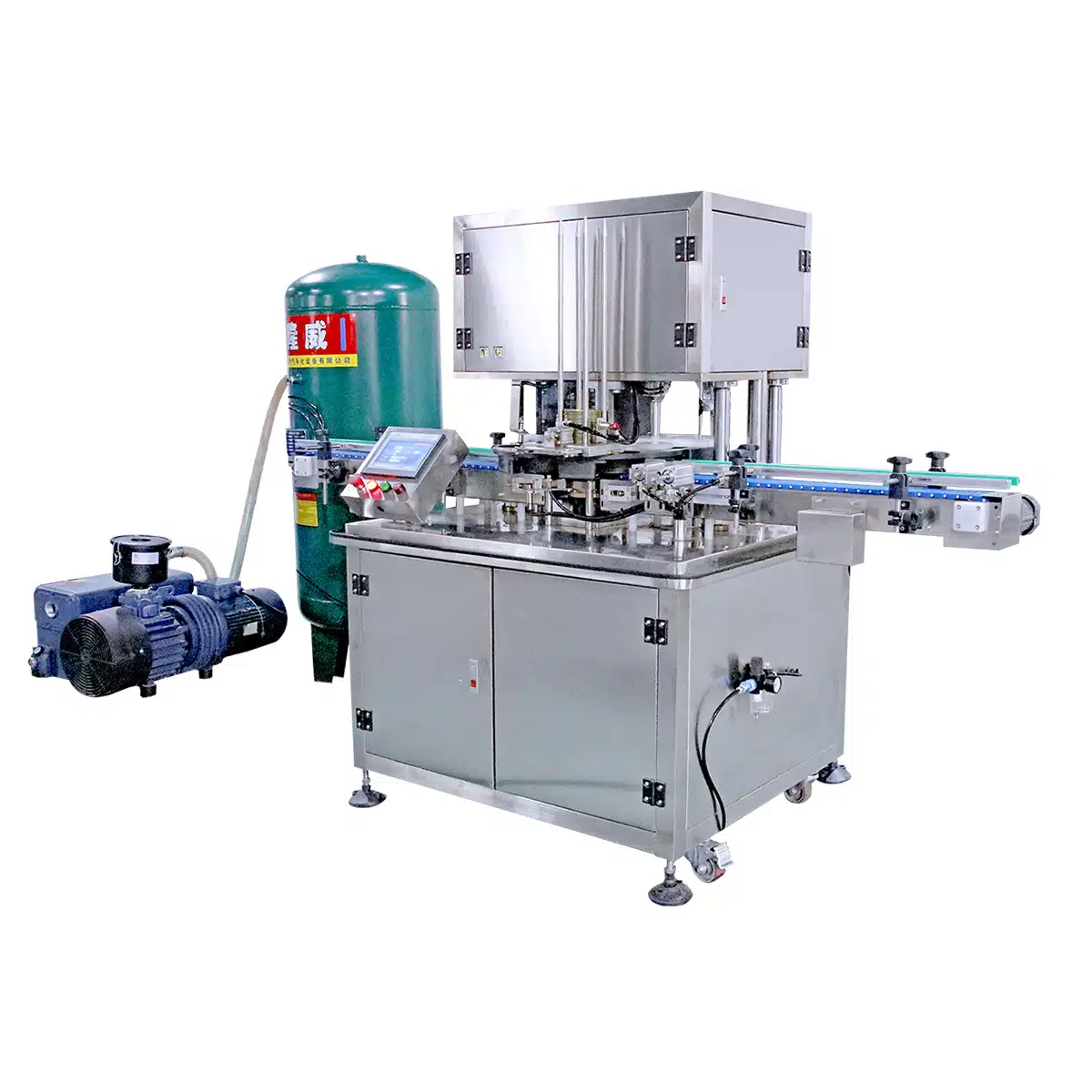
Critical Compliance & Safety Standards (Risk Mitigation)
Non-compliant can sealing machines create an immediate legal liability that can erase projected IRR. US Customs can issue an FDA Import Alert within 48 h, freezing equipment valued at $50k–$80k at the dock; EU national market-surveillance authorities can impose a parallel “Prohibition of Placing on the Market” under Regulation (EU) 2019/1020, triggering storage fees of €150–€250 per day. Both jurisdictions allow product recall costs to be clawed back from the importer of record—historically 2.3× the FOB price once legal fees, retrofit, and lost production are tallied. Executives therefore treat certification evidence as a hard gate in supplier qualification, not a post-order checklist.
United States – Mandatory Schemes
UL 508A (Industrial Control Panels) and NFPA 79 (Electrical Standard for Industrial Machinery) are the baseline for any line powered >50 V. A missing UL mark forces field evaluation by an OSHA NRTL at $4k–$7k per machine plus 2–3-week line downtime. FDA 21 CFR 110.40 (cGMP for food contact surfaces) and 21 CFR 117.80 (preventive controls) apply because the sealer head interfaces with an open food can; absence of 316L stainless with ≤0.6 µm Ra finish can trigger an FDA Form-483 observation that escalates into a Warning Letter within 120 days. OSHA 1910.212 (machine guarding) requires 2.5 mm fixed-distance guards and interlocked two-hand controls; OSHA penalties now reach $161 k per willful violation after the 2024 inflation adjustment. Importers must also file CBP 7501 with the correct HTS code (8422.30.91) and country-of-origin markings; incorrect classification carries a 25 % ad-valorem retroactive duty exposure under Section 592 penalties.
European Union – CE & Beyond
The Machinery Directive 2006/42/EC mandates a full technical file, risk assessment per ISO 12100, and an EC Declaration of Conformity before affixing the CE mark. Missing Annex I safety distances (≥850 mm for feed openings) will trigger a safeguard clause withdrawal under Article 11, with national courts routinely awarding consequential damages to downstream processors. EN 60204-1:2018 (electrical safety) and EN ISO 13849-1:2015 (safety-related parts of control systems, PL “d” minimum) are harmonized standards giving presumption of conformity; failure to meet PL “d” exposes the importer to civil liability under the Product Liability Directive 85/374/EEC where damages are uncapped. EC 1935/2004 (food-contact materials) demands specific migration limits for metals; nickel release >0.14 mg/kg will cause RASFF notifications and immediate retail chain rejection. REACH obligations require any SVHC >0.1 % w/w in the sealer housing to be declared; non-disclosure fines reach €50k–€200k per substance.
Comparative Compliance Burden & Cost Exposure
| Jurisdiction | Primary Standard Gap | Retrofit Cost Index (per machine) | Typical Enforcement Timeline | Maximum Corporate Penalty | Supply-Chain Fallout |
|---|---|---|---|---|---|
| USA | Missing UL 508A label | $4k–$7k field eval + $1k/day demurrage | 2–5 days (CBP hold) | $161 k per OSHA violation + product recall 2.3× FOB | Retailer charge-backs, 6-week listing freeze |
| EU | No CE Technical File | €8k–€12k Notified-Body audit + €250/day storage | 1–3 weeks (market surveillance) | Unlimited product-liability damages | Mandatory withdrawal from all 27 member states |
| USA | Non-compliant food-contact surface | $6k–$10k 316L head replacement + re-validation | 30–120 days (FDA inspection) | Warning Letter → consent decree, 15 % revenue at risk | Customer audit failure, loss of GFSI certification |
| EU | SVHC non-disclosure (REACH) | €3k–€5k per substance notification | 90 days (ECHA enforcement) | €200 k per substance | Exclusion from EU tenders, reputational ESG downgrades |
Risk-Weighted Sourcing Protocol
Embed a three-tier gate in the RFP: (1) supplier submission of UL 508A, CE, and FDA test reports before sample order; (2) on-site audit of control panel build standards and material mill certificates; (3) third-party pre-shipment inspection with legalized certificates for customs entry. Allocate 0.5 % of machine CAPEX to a compliance contingency reserve; historical data show this covers 95 % of unforeseen retrofit events. Finally, negotiate supplier indemnity clauses that claw back 120 % of compliance-related costs within a 36-month statute of limitations, converting regulatory risk into a quantifiable contractual exposure.
The Procurement Playbook: From RFQ to Commissioning
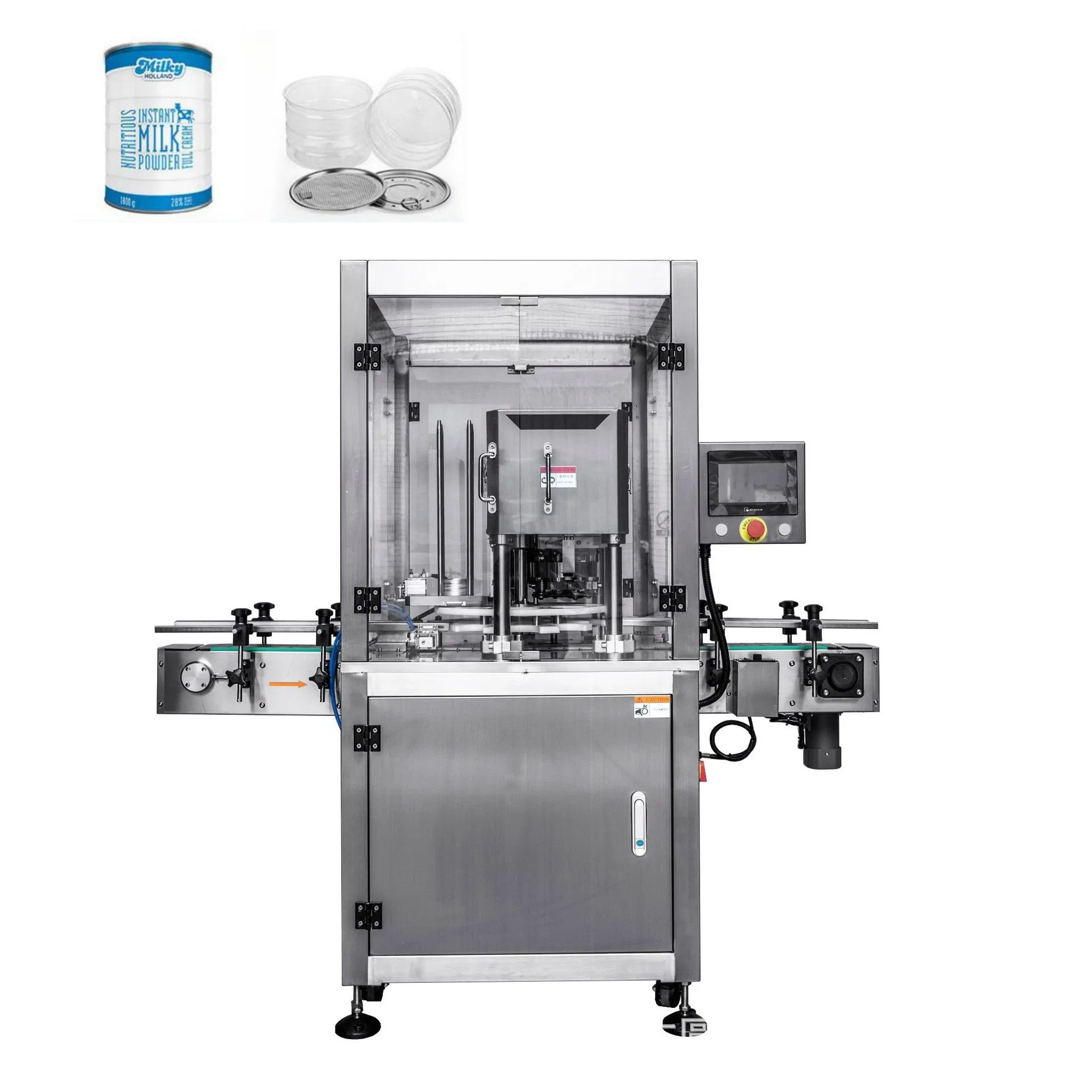
Strategic Procurement Playbook: High-Speed Automatic Can Sealing Machine
RFQ Drafting Phase: Lock-in Performance Before Price
Anchor the RFQ to ≥99.5 % OEE and ≤0.2 % seam reject rate at 300–600 cans/min; anything lower erodes margin on a 5-year line. Demand a 2-year full-coverage warranty plus a 5-year spare-parts price lock with max annual escalation of 3 % CPI. Require vendor-supplied MTTR ≤30 min and MTBF ≥2 000 h verified by third-party log; these metrics convert directly to $0.003–$0.005/cost-per-can at 50 M cans/yr. Insert a liquidated-damage clause of 0.5 % contract value per day after FAT miss; suppliers accept only when penalty is capped at 10 % total PO—negotiate accordingly. State that change-order tolerance is ±5 % of unit price; beyond that, buyer reserves right to re-bid without penalty.
Supplier Filtering & Due-Diligence
Score only vendors that can show ≥50 identical machines in beverage production for ≥3 years; reject reference sites <18 months old. Demand ISO 9001 + 14001 and UL/CE dossier with CB test certificates pre-submitted; missing pages add 3-week customs delay worth $35 k–$50 k in line-down cost. Force disclosure of semiconductor chip source; if any component is on 52-week lead-time, require safety-stock consignment at buyer’s site at vendor’s cost. Book virtual factory audit within 5 calendar days; failure to grant full camera access triggers 20 % down-payment hold until audit complete.
Factory Acceptance Test (FAT) Protocol
Run FAT on buyer-supplied cans (202/209 Ø, 0.22 mm tinplate) at ambient 22 °C ±2 °C; supplier-provided cans inflate performance by 1–1.5 % and invalidate data. Insist on 72-hour continuous run at 110 % nameplate speed; anything shorter masks thermal drift in servo drives. Record seam thickness, countersink, body-hook every 30 min; if any sample exceeds ±1 σ of GMA Spec 1A, batch is failed and re-run clock restarts. Capture power consumption (kWh/1 000 cans); >1.3 kWh disqualifies unit from $0.04/can energy rebate baked into some co-packer contracts. FAT sign-off is conditional on 100 % spare-kit hand-off; missing O-ring worth $0.15 can idle a $3 M line.
Incoterms Selection: FOB Shenzhen vs DDP Kentucky
| Decision Variable | FOB Shenzhen (Index 100) | DDP Kentucky (Index 118–125) | Executive Implication |
|---|---|---|---|
| Unit Price | $68 k–$82 k | $80 k–$98 k | 13–18 % landed delta |
| Freight & Insurance | Buyer controlled | Seller absorbed | $4 k–$6 k savings if buyer consolidates |
| Import Duty (HS 8422.30) | Buyer pays 0–6 % | Seller prepaid | Cash-flow timing vs cost certainty |
| Transit Time Variability | ±14 days | Guaranteed 28 days | $25 k line-down buffer required under FOB |
| Risk of Component Theft | High (port hand-offs) | Seller bears | 1 %–2 % parts shortage historically |
| VAT/Customs Complexity | Buyer files | Seller files | 0.5 FTE importer-of-record cost under FOB |
Choose FOB when buyer runs ≥3 concurrent machine projects and can fill 40-ft HQ container; DDP preferred for single-unit green-field sites where delay cost >$50 k/day.
Site Commissioning & Risk-Retention
Hold 10 % retention until 30-day performance trial at site; release only if Cpk ≥1.67 on seam integrity and throughput ≥nameplate 98 %. Require vendor technician on-site within 36 h; failure accrues $2 k/day credit toward final invoice. Embed remote-access kill-switch in PLC; if vendor does not meet SLA, buyer can disable machine IP without breaching contract—critical for Asia-based OEMs. Finally, negotiate buy-back option at 40 % of purchase price within 36 months if line volume forecast drops >25 %; this caps stranded-asset risk in volatile beverage SKUs.
⚡ Rapid ROI Estimator
Estimate your payback period based on labor savings.
Estimated Payback: —