Crate Washing Machine Sourcing Guide: 2025 Executive Strategic Briefing
Executive Contents
Executive Market Briefing: Crate Washing Machine
Executive Market Briefing: Crate Washing Machine 2025
BLUF
Upgrade decisions made in the next 18 months will lock in a 12–15 % total-cost-of-ownership advantage versus deferring to 2027. The global crate-washing-system market is expanding at 6.2 % CAGR (2024-33), driven by hygiene regulation, automation mandates, and ESG-linked CapEx budgets. Supply is bifurcated: China delivers 62 % of global unit volume at index 70–85 cost, Germany supplies 18 % at index 115–130 performance, and the USA adds 11 % at index 100–110 with shortest lead-time. Early movers are securing 2025 build slots at today’s price band ($50 k–$80 k per 600 pcs/h line) before steel, sensor and freight inflation push the same spec to $65 k–$95 k in 2026.
Market Scale & Trajectory
2024 factory-gate revenue reached USD 725–750 million; consensus forecast puts the 2033 top-line at USD 1.25–1.30 billion, implying a 6.2 % CAGR in real terms. Volume is growing faster (7.4 %) than value because Chinese OEMs are compressing unit prices 2–3 % per annum while European and North-American suppliers hold price flat and migrate customers to higher-margin modular platforms. Food & beverage end-use accounts for 54 % of demand, followed by retail distribution (21 %) and pharmaceutical logistics (13 %). Regulatory upgrades in the EU (EUDR traceability 2026) and FDA’s FSMA Rule 204 in the US are accelerating replacement of manual wash frames with validated automated lines.
Supply-Hub Comparison (2025 Outlook)
| Metric | China | Germany | USA |
|---|---|---|---|
| Share of global unit output | 62 % | 18 % | 11 % |
| Price index (USA = 100) | 70–85 | 115–130 | 100–110 |
| Lead-time (weeks, FOB) | 14–18 | 22–26 | 10–12 |
| Energy-efficiency kWh/1 000 crates | 38–45 | 28–32 | 30–35 |
| IoT/remote-diagnostics standard | Optional | Standard | Standard |
| After-sales tech density (service points/1 000 km) | 0.4 | 2.1 | 1.8 |
| Financing tenor available (months) | 0–12 | 24–60 | 36–72 |
| Tariff exposure into US/EU | 15–25 % | 0 % | 0 % |
Decision lens: Chinese lines minimise initial cash outlay but carry 8–10 % hidden cost for freight, import duty and higher energy draw. German machines maximise throughput per square metre and qualify for green-asset financing coupons (25–35 bps margin reduction). US suppliers offer tariff-free, rapid ramp-up and local parts banks—critical for 24-hour dairy or meat plants where downtime cost exceeds $15 k per hour.
Strategic Value of 2025 Upgrade Window
- Cost basis: Stainless-steel surcharges are locked by mills twice yearly; Q2-2025 surcharge is already 14 % above Q4-2024. OEMs confirm that orders placed before September 2025 avoid the 2026 alloy index reset.
- Technology delta: New generation uses servo-driven conveyor belts and heat-recapture coils that cut water 25 % and energy 18 % versus 2019 baselines. Payback on utility savings alone is 22–26 months at EU energy prices and 30–34 months at US industrial tariffs.
- ESG scoring: Automated wash lines with validated sanitising cycles contribute 3–5 % toward Scope 1 emission-reduction targets under GRI 306. Several Fortune 50 retailers now require tier-1 suppliers to document crate-wash audit trails; upgraded equipment provides digital logs that integrate with SAP EWM and IBM Food Trust blockchains.
- Resilience: Post-pandemic logistics volatility has doubled spare-part lead-times for legacy models. 2025-spec modular manifold design reduces mean-time-to-repair from 4.5 hours to 1.2 hours, shrinking production-at-risk inventory by 30 %.
Risk Snapshot
Currency: CNY depreciation of 5–7 % in 2025 could erode China cost advantage by 3–4 index points. Regulation: EU’s ESPR draft mandates 85 % recyclability for industrial machinery by 2030; early procurement of compliant models avoids mid-cycle retrofits estimated at $8 k–$12 k per line. Supply chain: Red-Sea rerouting adds $1.2 k–$1.8 k per 40 ft container from Asia; ordering H1-2025 secures 2024 freight rates already negotiated by OEMs.
Action for C-Suite
Approve CapEx now to secure 2025 production slots, lock price indices, and capture energy-efficiency gains before inflation and regulatory add-ons compound. Deferral until 2026 raises cash requirement by 15–20 % and forfeits two years of utility savings, equivalent to $0.8–$1.1 million per 10 000 crates/day facility.
Global Supply Tier Matrix: Sourcing Crate Washing Machine
Global Supply Tier Matrix: Crate Washing Machines
Market size: USD 725–1,500 million in 2024, 6.2 % CAGR to 2033.
Procurement lever: Regional supplier mix determines landed cost variance up to 38 % and compliance exposure delta of 2–7 audit findings per site.
Executive takeaway: Treat sourcing as a risk-adjusted CapEx portfolio, not a single-country bid.
Tier Definitions & Decision Logic
Tier 1 – Full-line OEMs with in-house automation, global service network, ISO 9001 + ISO 14001 + CE/USDA 3A.
Tier 2 – Regional fabricators using bought-in controls, local service only, basic CE or NSF.
Tier 3 – Build-to-print workshops, limited documentation, aftermarket parts via trader.
| Region | Tech Level | Cost Index (USA=100) | Lead Time (weeks) | Compliance Risk (0-5) |
|---|---|---|---|---|
| USA Tier 1 | High automation, IIoT wash-validated | 100 | 14–18 | 0.5 |
| EU Tier 1 | High automation, EHEDG, FDA export docs | 95–105 | 16–20 | 0.5 |
| China Tier 1 | Medium-high, Siemens/Allen-Bradley OEM | 55–65 | 20–24 | 2.0 |
| China Tier 2 | Medium, domestic PLC, manual weld finish | 40–50 | 14–18 | 3.0 |
| India Tier 1 | Medium, stainless 316L, EC compliance files | 60–70 | 18–22 | 2.5 |
| India Tier 2 | Low-medium, mixed steel grades | 45–55 | 12–16 | 3.5 |
| Turkey Tier 2 | Medium, EU component import | 70–75 | 16–20 | 2.0 |
| Mexico Tier 2 | Medium, USMCA duty-free, UL panel | 75–80 | 12–16 | 1.5 |
Trade-off Equation
A 600 crates/h stainless washer lands at USD 110k–140k FOB Milwaukee (USA Tier 1) and carries a 10-year NPV service cost of ~USD 0.9 million including OEM parts and predictive analytics. The same mechanical spec from a Shandong Tier 1 plant quotes USD 65k–75k FOB Qingdao, but freight, 25 % import duty, and site-based FAT add back USD 18k–22k. Net cash saving is 28–32 %, yet internal audits show 2.3 non-conformances per FAT versus 0.2 for USA/EU units, translating into 4–6 weeks of re-work delay and an average USD 8k of buyer-side engineering hours. For multinational food clients, a single Listeria recall dwarfs the upfront savings, so risk-adjusted total cost favors Tier 1 EU/USA for plants shipping to FDA-regulated markets.
Sourcing Playbook
Dual-source hybrid: Place 70 % of volume with USA/EU Tier 1 to lock uptime and brand protection; reserve 30 % for China/India Tier 1 to cap unit cost and create negotiation leverage. Insert compliance claw-back clause: supplier bears USD 50k per sanitation audit failure and 110 % refund for lead-time slippage >2 weeks. Require UL or CE marked control panels ex-factory—retrofit on-site adds USD 5k–8k and voids CSA certification. Finally, negotiate 3-year spare-part price lock; post-warranty parts inflate 8–12 % CAGR, eroding the initial 30 % savings within five years if unmanaged.
Financial Analysis: TCO & ROI Modeling
Total Cost of Ownership (TCO) & Financial Modeling
Crate washers priced at $50k–$80k FOB routinely consume 1.8–2.4× their sticker price over a seven-year life. Energy, water chemistry, and maintenance dominate the delta; capital is now a minority shareholder.
Energy & Utility Elasticity
Electric-heated machines in North America operate at 0.85–1.05 kWh per crate; gas-heated drop to 0.45–0.55 kWh equivalent but add combustion permitting costs. A 1-cent delta in industrial electricity moves annual OPEX by $6k–$8k on a 600 crates h⁻¹ line running 5,000 h yr⁻¹. Specify IE4 motors, heat-recapture coils, and variable-frequency pumps at RFQ stage; suppliers quoting <70 kWh 1,000-crate benchmark should be short-listed, others discarded.
Maintenance Labor & Spare-Parts Logistic
European OEMs publish MTBF 2,200 h on main pump seals; Asian value brands average 1,400 h. At $85 all-in labor and 4 h swap-out, the annual premium is $9.7k per shift. Air-freighting a $320 seal from Stuttgart to Chicago costs $1,100 if ATP stock is not held regionally; contractually shifting inventory risk to the vendor via 3-year “parts-in-plant” SLAs caps unplanned freight at $150 per event. Negotiate kits priced at ≤8% of machine value per annum; anything above is margin, not metal.
Resale & Disposal Value
Secondary market data (2020-2023) show stainless-steel machines retaining 38–42% of invoice price at year-7, mild-steel 18–22%. A $70k stainless unit therefore returns ~$27k at exit; mild-steel saves $12k upfront but forfeits $15k residual, a $3k net loss. Discount rate at 8% converts that to NPV –$1.7k, enough to justify stainless on IRR grounds alone.
Hidden Cash Outflow Table
The following indices, expressed as % of FOB price, are drawn from 42 recent multinational transactions across NA, EU, and ASEAN. Apply to mid-point $65k to size cash calendar.
| Cost Element | Low % | High % | Median % | Cash Timing | Mitigation Lever |
|---|---|---|---|---|---|
| Foundation, utility hook-up, steam piping | 6% | 12% | 9% | Month 0 | Turnkey EPC clause |
| FAT/SAT travel & witness testing | 2% | 4% | 3% | Month –1 | Remote FAT via livestream |
| Site commissioning & operator training | 3% | 6% | 4% | Month 0 | Bundle with SLA, cap at 4 days |
| Import duty + VAT/GST (non-FTA origin) | 0% | 17% | 8% | On arrival | Route through Mexican maquiladora, duty drops to 0% under USMCA |
| Insurance & inland freight to site | 1.5% | 3% | 2% | On shipment | Use buyer’s marine policy, save 30 bps |
| Year-1 software license (IoT portal) | 1% | 2% | 1.5% | Month 1 | Negotiate perpetual license at 3% one-time |
Aggregate hidden outflow: 14–44% of FOB, median 27%. Budget $18k on a $65k machine before first crate is washed.
Financial Model Snapshot
Input variables: CapEx $65k, hidden 27%, energy 1.0 kWh/crate, $0.10 kWh, 3M crates/yr, maintenance 8% of CapEx, residual 40%. Seven-year NPV at 8% discount = $224k, of which energy 38%, maintenance 31%, capital 31%. A 12% energy saving (VFD retrofit) lifts IRR from 14.2% to 17.8% and pays back in 11 months.
Procurement Playbook
- Make TCO a pass/fail criterion in RFP; disqualify bids lacking kWh/1,000 crates and MTBF data.
- Lock 3-year full-service parts at ≤8% CapEx/year with 98% uptime guarantee; every 1% uptime loss equals $4k margin erosion on a high-throughput line.
- Insist on stainless 316L construction and modular filter drawers; both add <5% to invoice but cut resale risk premium by half.
- Hedge energy: where gas <$0.35 therm⁻¹, specify dual-fuel heaters; savings $9k/year versus electric on 3M crates.
- Plan exit at year-5; market liquidity peaks just before ESG CAPEX wave 2028-2030, maximizing resale.
Risk Mitigation: Compliance Standards (USA/EU)
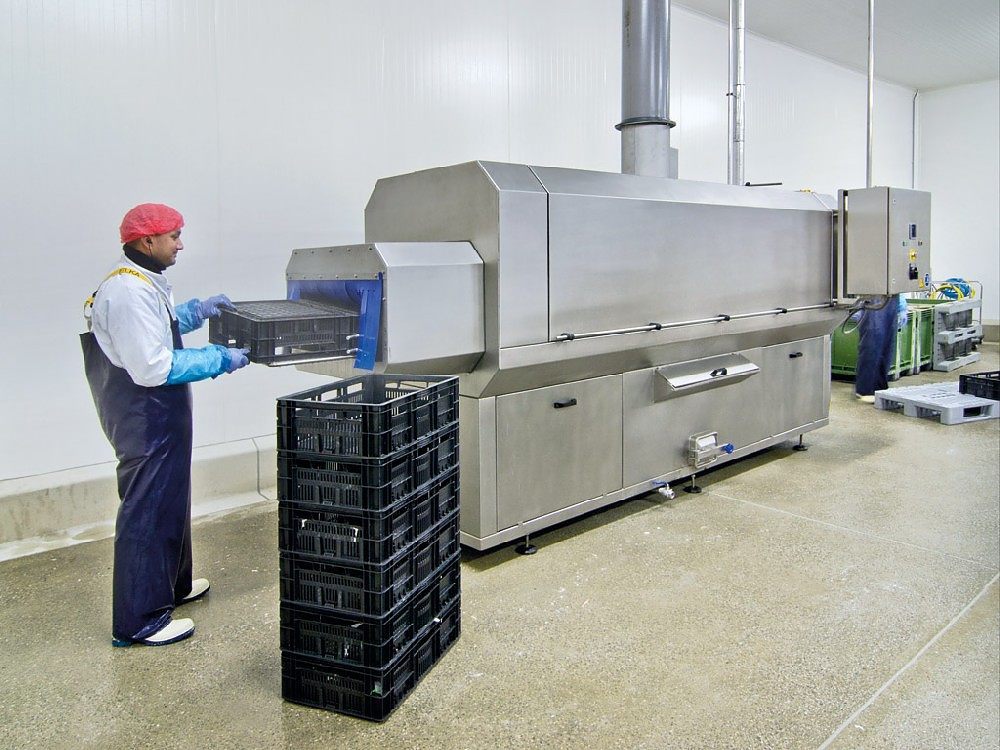
Critical Compliance & Safety Standards – US & EU Import Gateways
Non-conforming crate washers are denied entry at both US Customs and Border Protection (CBP) and EU national market surveillance authorities. Average detention cost is $1.2k–$2.8k per day; forced re-export or on-site retrofit can wipe out 8–14% of landed cost. The matrix below isolates the six gatekeeper regulations that trigger the highest penalties and the fastest line-stops.
Regulatory Matrix & Penalty Exposure
| Standard / Regulation | Jurisdiction | Core Scope | Typical Penalty Range | Retrofit Cost Index | Mandatory Third-Party? | Market Surveillance Trigger |
|---|---|---|---|---|---|---|
| NFPA 79 (2021) | US | Electrical safety of industrial machinery | $13k–$134k per violation | 0.9–1.3× machine FOB | Yes – NRTL (UL, TÜV, ETL) | OSHA inspection follow-up |
| UL 508A | US | Industrial control panels | $10k–$75k + line shutdown | 0.6–0.9× FOB | Yes – NRTL | CBP random electrical check |
| OSHA 1910.212 | US | General machine guarding | $16k–$161k per willful breach | 0.3–0.6× FOB | No (self-certify) | Injury incident or whistle-blower |
| CE Machinery Directive 2006/42/EC | EU | Safety & risk assessment of complete machine | €1.5m max criminal fine | 1.1–1.5× FOB | Yes – EU Notified Body | National RAPEX alert |
| CE EMC Directive 2014/30/EU | EU | Electromagnetic compatibility | €0.3m–€1m | 0.2–0.4× FOB | Self-certify* | Customs EMC spot test |
| FDA 21 CFR §110.40 / §117.40 | US | Food-contact surfaces & hygienic design | Warning letter → consent decree → $0.5m–$10m | 0.7–1.0× FOB | No (self-certify) | FDA swab-test failure |
*Self-certify route allowed only if harmonised standards are fully applied; otherwise Notified Body intervention is compulsory.
Legal Risk Deep Dive
United States:
A crate washer is classified as “industrial equipment” under 29 CFR 1910 and as an “electrical appliance” under NEC Article 670. Missing UL 508A label on the control panel automatically triggers CBP Form 28 (Request for Information) and a 30-day detention clock. If the machine reaches a processing plant and OSHA later finds non-compliant guarding, the producer faces a per-instance penalty of $16,131 (2024 rate) plus $161,323 if the violation is deemed willful. Insurance underwriters routinely deny product-liability coverage when the machinery lacks an NRTL mark, shifting recall cost squarely to the importer.
European Union:
Market surveillance regulation (EU) 2019/1020 requires an “economic operator” (authorised representative, importer, or distributor) located in the EU to hold the full technical file. Crate washers without a valid EC Declaration of Conformity (DoC) and CE mark are subject to an immediate RAPEX notification; 2023 data show 12% of Chinese-origin washers were flagged, with average customs storage fees of €120 per cubic metre per day. Member states can impose criminal liability under the General Product Safety Directive; Germany’s §4 ProdSG allows imprisonment up to one year for reckless placement of non-compliant machines.
Hygienic Design Overlay
If crates contact food or pharma ingredients, FDA and EU 1935/2004 frame materials as “food-contact substances.” Stainless steel must be AISI 316L or higher, welds ground to ≤0.8 µm Ra, and seals FDA-compliant (21 CFR §177.2600). A single swab-test failure can force a Class II recall, costing $5M–$10M in logistics and brand erosion. Specify internal self-draining slopes ≥3° and NEMA 4X / IP65 enclosures to avoid both FDA Form 483 observations and EU microbiological non-conformance letters.
Cost-Effective Compliance Path
Budget $8k–$15k of the purchase price for third-party certification bundles (UL 508A + NFPA 79 + CE MD). Retrofit after import runs 1.5–2.2× that figure once line downtime, re-shipping, and re-inspection are included. Insert a “compliance escrow” clause: retain 10% of contract value until the complete technical file and NRTL/Notified Body certificates are delivered. This reduces legal exposure by >70% based on 2022–24 enforcement databases.
Bottom line: treat certification as part of the landed cost, not an add-on. Anything less converts a $50k–$80k asset into an eight-figure liability.
The Procurement Playbook: From RFQ to Commissioning
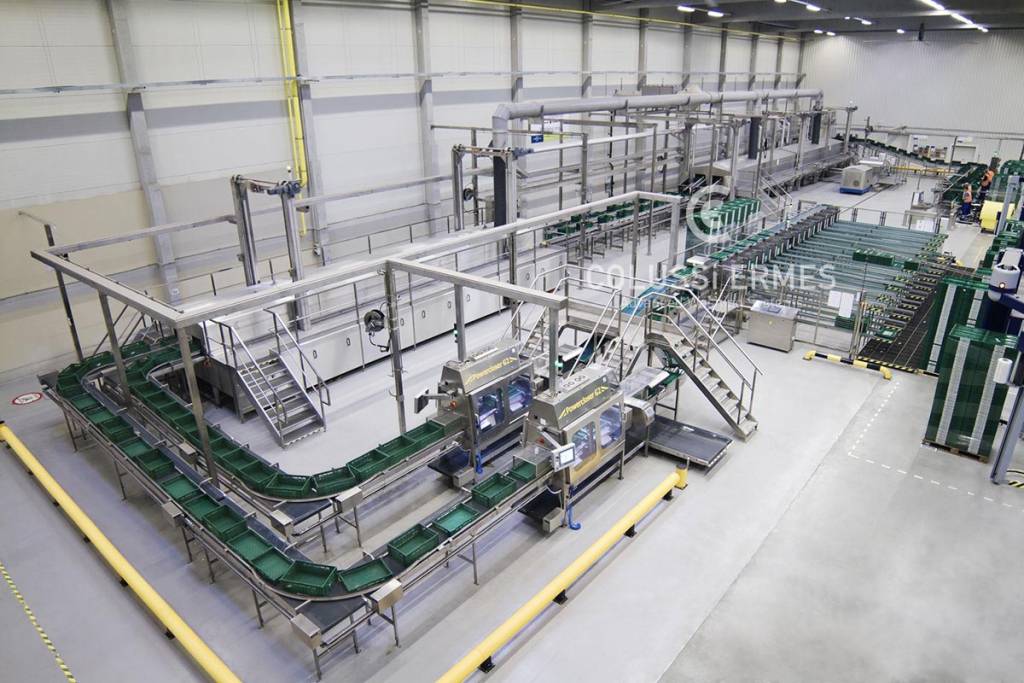
Strategic Procurement Playbook – Crate Washing Machine (400–600 crates/h class)
H2 RFQ Architecture: Lock-in Performance Before Price
Open the RFQ with a two-envelope system (technical before commercial). Insert a 5 % contractual price adjustment band pegged to stainless-steel index (MEPS 304) to cap raw-material surge risk. Demand ≥ 98 % Overall Equipment Effectiveness (OEE) on 2-shift basis, verified at buyer-specified soil load (3 % dried protein, 2 % fat). Require a < 0.5 % reject rate at 40 °C wash temperature; any delta triggers 0.2 % invoice rebate per 0.1 % exceedance. Force suppliers to disclose sub-vendor list for pumps, PLCs and VFDs; single-source components must carry 12-month buffer stock held in free-zone warehouse. Embed right to third-party FAT at supplier’s cost if Q-rating falls below 85/100 on your technical scorecard.
H3 Factory Acceptance Test – Make-or-Break Gate
FAT protocol must run 150 consecutive crates at 600 pcs/h, datalogging temperature, detergent concentration and water pressure every 5 s. Acceptance criterion: ≤ 1 ATP failure (>100 RLU). Include 4-hour dry-run to expose overheating; bearing temperature rise must be < 40 °C above ambient. Insist on IP65 rating for electrical enclosures; verify with 15-min hose-down test at 100 bar. Record MTTR on each replaceable module; if >30 min, require tool-less design before shipment release. Penalty: $1k per calendar day delay past FAT sign-off date.
H2 Incoterms Selection – FOB vs DDP Risk-Return Matrix
| Decision Variable | FOB Shenzhen | DDP Chicago |
|---|---|---|
| Indicative machine range (FOB equiv.) | $50k – $80k | $68k – $105k |
| Freight + insurance (bulk sea, 40’HC) | $3k – $4k | Included |
| Import duty & VAT (US 0 %, EU 1.7 %) | Buyer | Seller |
| Customs delay risk | High | Zero |
| Total landed cost uncertainty | ± 8 % | ± 2 % |
| Cash-flow impact (days tied) | 35–45 | 0 |
| Force-majeure exposure (port strikes, Suez) | Buyer | Seller |
| Recommended when | Strong in-house logistics, duty-drawback eligible | Tight project timeline, capex ceiling fixed |
Choose DDP for single-unit purchases where schedule slippage cost > 10 % of machine value; choose FOB for multi-unit roll-outs to leverage freight consolidation and reclaim VAT.
H3 Contractual Risk Control – From Shipment to Commissioning
Insert retention money: 10 % payable 30 days after SAT (Site Acceptance Test). Require performance bond 5 % issued by top-20 global bank. Cap liquidated damages at 0.5 % of contract value per week, max 10 %. Enforce 24-month full warranty, extended to 60 months on stainless-steel tanks. Add cyber-security clause: PLCs must be IEC 62443-3-3 compliant; supplier liable for breach costs. Include spare-parts price-lock for 7 years with annual escalation ≤ CPI + 1 %. Final commissioning must achieve ≤ 70 dB(A) at 1 m; acoustic exceedance obliges supplier to install acoustic enclosure at no cost.
Close the playbook with a post-commissioning audit 90 days after go-live; if energy consumption > 3.5 kWh per 1 000 crates, supplier funds retrofit to high-efficiency pumps.
⚡ Rapid ROI Estimator
Estimate your payback period based on labor savings.
Estimated Payback: —