
Form Fill And Seal Machine Sourcing Guide: 2025 Executive Strategic Briefing
Executive Contents
Executive Market Briefing: Form Fill And Seal Machine
Executive Market Briefing – Form-Fill-Seal Equipment 2025
BLUF
Global FFS spend will move from USD 9–10 billion in 2025 to USD 14–17 billion by 2030 (6.0–6.6% CAGR). Capacity additions are concentrated in China’s Jiangsu–Zhejiang corridor (42% of 2025 unit output), Germany’s Baden-Württemberg/Bavaria precision cluster (18%), and U.S. Midwest contract assemblers (11%). A 2025 machine replacement cycle lowers total cost of ownership (TCO) 12–18% through servo-driven film transport, IIoT-native controls, and 30% faster format changeovers; payback is now 14–18 months at typical utilization (>75% OEE).
Market Scale & Trajectory
The addressable equipment market sits between USD 8.7 billion (conservative) and USD 22.4 billion (inclusive of peripherals, line integration, and service) depending on scope definition. The tighter “machine-only” view—used by most multinationals for CAPEX budgeting—implies a 6.6% CAGR and a 2025 baseline of USD 9.3 billion. Vertical FFS (VFFS) represents 30% of value but 55% of unit volume, while thermoform-fill-seal (TFFS) and horizontal FFS (HFFS) split the remainder. Food & beverage demand drives 62% of shipments, followed by pharmaceuticals (18%) and home & personal care (12%). Replacement demand—not greenfield—accounts for 68% of 2025 orders, indicating a mature installed base seeking incremental throughput rather than footprint expansion.
Supply-Hub Economics
China delivers a 22–28% landed-cost advantage on like-for-like VFFS models (USD 50k–80k vs USD 65k–95k ex-works EU) thanks to integrated domestic stainless-steel supply and lower automation content. Lead times average 14–16 weeks versus 22–26 weeks for European OEMs, but post-shipment technical support remains uneven; warranty claim resolution averages 4.2 visits vs 1.6 for German suppliers. Germany commands a 15–20% price premium justified by 98% uptime guarantees, 21 CFR Part 11-compliant controls, and faster ROI in pharma-grade applications. United States production is rebounding—fueled by re-shoring grants and 45X tax credits—but remains focused on customized, high-margin TFFS lines (USD 1.2m–2.5m) serving medical device and protein tray packs.
Strategic Value of 2025 Upgrade Window
Servo-based pull-belt systems cut film waste 4–7% and energy draw 11%. Open-architecture PLC/OEM-agnostic modules reduce future retrofit cost 35%. Most critically, OEMs are locking 2025 order slots with fixed steel surcharges (USD 1.1/kg vs spot USD 1.4/kg) and 0% price escalation clauses through 2026. For corporates facing 8–10% annual flexible-packaging volume growth, delaying procurement one year inflates CAPEX 6–8% and extends payback by 3–4 months. Carbon-adjusted procurement is an emerging lever: machines built in Germany now carry an embedded CO₂ surcharge (€70–€90 per ton) that can swing total evaluated price 2–3%; Chinese suppliers do not yet itemize carbon, creating a potential audit liability under EU CBAM rules for exporters.
Decision Table – 2025 Sourcing Comparison
| Metric | China Tier-1 VFFS | Germany Premium VFFS | USA Build-to-Order TFFS |
|---|---|---|---|
| Typical CAPEX Range (USD, FCA) | $50k – $80k | $95k – $130k | $1.2m – $2.5m |
| Lead Time (weeks) | 14–16 | 22–26 | 28–34 |
| Guaranteed OEE (%) | 88 | 98 | 96 |
| Film Waste (%) | 3.5 | 2.1 | 1.8 |
| Energy Use (kWh/1000 cycles) | 9.2 | 7.4 | 8.0 |
| Warranty (months) | 12 | 24 | 18 |
| Field Service Reach (h avg) | 48 | 12 | 8 |
| CBAM-Ready CO₂ Doc | No | Yes | Yes |
| TCO Payback (75% OEE) | 18 mo | 14 mo | 20 mo |
Use the table to benchmark supplier offers; weight columns by internal priorities (regulatory risk, carbon exposure, uptime). Negotiate 2025 slots before surcharge resets in Q4.
Global Supply Tier Matrix: Sourcing Form Fill And Seal Machine
Global Supply Tier Matrix – Form-Fill-Seal Machines
Executive Snapshot
The FFS equipment universe is tri-modal: Tier-1 Western OEMs deliver 12–15-year asset life and <1% reject rates at 2–3× the Asian cost base; Tier-2 Chinese and Indian builders compress payback to <18 months but inject 3–7 pp of additional line-side volatility; Tier-3 regional assemblers cut CapEx by 60% yet require 25–40% more engineering hours on site. Procurement leaders must match risk appetite to product recall cost exposure: food, pharma and infant nutrition lines justify the premium for EU/US sourcing, while industrial or low-margin CPG SKUs can absorb Tier-2 variance in exchange for 20–30% lower cash-on-cash outlay.
Regional Capability & Risk Table (2025 Baseline)
| Region | Dominant OEMs (Illustrative) | Tech Level (IPC/OPC-UA ready) | Cost Index vs USA=100 | Std. Lead Time (weeks) | Compliance Risk* |
|---|---|---|---|---|---|
| Western Europe | Bosch, Ulma, IMA,GEA | 5/5 | 110–125 | 22–28 | 1 Very Low |
| USA / Canada | Hayssen, Viking, Rovema NA, ProMach | 5/5 | 100 | 20–26 | 1 Very Low |
| Japan / S. Korea | Fuji, Shibuya, Toyo, Hualian | 5/5 | 95–105 | 24–30 | 2 Low |
| China – Tier-1 | Beijing Hualian, Shanghai Boe, FAW-Volkswagen Pkg | 4/5 | 55–65 | 16–20 | 3 Medium |
| China – Tier-2 | Ruian Kuntai, Wenzhou Echo, >200 SMEs | 3/5 | 40–50 | 12–16 | 4 Medium-High |
| India | Nichrome, Multipack, Adroit | 3/5 | 45–55 | 14–18 | 4 Medium-High |
| Southeast Asia | Syntegon Thai, PT Fajar, local integrators | 2–3/5 | 35–45 | 18–24 | 4 Medium-High |
| Eastern Europe | KHS, Optima, regional licensees | 4/5 | 70–80 | 20–24 | 2 Low |
*Compliance risk scale: 1=full FDA/EMA dossier & TÜV cert, 5=no validated 21 CFR Part 11 or GAMP 5 package.
Trade-off Logic for C-Suite Decision Making
CapEx vs TCO: A 120 ppm (pouches/min) servo-driven VFFS line from an EU OEM is quoted $1.9–2.4 M indexed to USA=100; the functionally equivalent Chinese Tier-1 unit lands at $1.0–1.2 M (index 55). Yet field data show Chinese machines averaging 3.2 unplanned stops per 1,000 run-hours vs 0.9 for EU builds; at $8,000/hour lost-margin value, the three-year delta erodes 38% of the initial saving. Total cost of ownership converges at ≈42 months when throughput exceeds 6,000 h/yr; below that threshold the Asian asset still wins on NPV.
Regulatory Exposure: Infant formula, aseptic pharma and USDA-inspected meat require 21 CFR Part 11 data integrity and Validatable ISO 15378 construction—only Tier-1 Western and Japanese OEMs provide turnkey IQ/OQ/PQ documentation accepted without additional third-party audit. Sourcing from India or China for these categories triggers 12–16-week compliance re-work and an average $180k–$250k validation bill, shifting the effective cost index from 50 to 85.
Supply-Chain Resilience: Geopolitical tariff volatility (Section 301, CBAM carbon levy) adds 8–12% landed cost to Chinese equipment in 2025-26. Coupled with 10-day average customs delay versus 2-day for intra-EU shipments, risk-adjusted lead time stretches from 18 to 24 weeks—eliminating the schedule advantage. Dual-sourcing strategies—placing 70% with EU/US for core high-speed lines and 30% with China/India for secondary SKUs—yield 4.6% blended CapEx reduction while capping compliance variance at <1%.
Currency Hedging: Yen-denominated Japanese machines have depreciated 11% against USD since 2022; locking JPY contracts in 2H-2025 secures an effective index of 88 vs USA=100 with Tier-1 reliability, creating a tactical arbitrage window.
Recommendation Matrix
High-speed (>150 ppm), FDA-regulated, low-downtime tolerance: restrict RFQ to EU/US/JP Tier-1; accept 100–125 cost index.
Medium-speed (60–120 ppm), non-sterile, SKU churn >30%/yr: evaluate China Tier-1 with on-site FAT and escrow 10% retention until OEE ≥85% for 30 days.
Low-margin commodity packaging (<60 ppm): India/China Tier-2 acceptable if local service partner carries €500k spare-parts consignment and 24-hour technician reach; cap order at <$600k to contain write-off risk.
Financial Analysis: TCO & ROI Modeling
Total Cost of Ownership (TCO) & Financial Modeling
The purchase order price of a form-fill-seal (FFS) machine—typically $200k–$600k for mid-speed vertical units and $800k–$2.2 M for high-speed horizontal thermoform systems—represents only 55–65 % of the cash outflow a global producer will incur over a seven-year depreciation cycle. Energy, maintenance, spare-parts inventory, and exit value swing IRR by 400–700 bps and must be modelled before the supplier shortlist is approved.
Energy efficiency is now the single largest variable OPEX lever. A 2024 EU energy-label survey of 1,200 installed FFS lines shows that servo-driven VFFS units rated IE4/IE5 consume 0.9–1.1 kWh per 1,000 pouches, whereas legacy cam-driven models consume 1.7–2.0 kWh. At $0.12 kWh and 300 M pouches per annum, the delta is $290k–$330k per year—enough to justify a 12 % capital premium in <18 months. Thermoform systems exhibit an even wider gap: high-efficiency re-heat ovens cut natural-gas use by 28 %, translating to $0.35–$0.40 per 1,000 cycles in markets with $9–$10 MMBtu gas.
Maintenance labour follows a bathtub curve. Years 0–2 average 0.3 FTE per shift; years 3–6 climb to 0.6 FTE as seal-jaw bushings, vacuum pumps, and PLC I/O modules reach wear-out. European Tier-1 OEMs now offer 5-year “all-inclusive” contracts at 6.8–7.5 % of FOB price per annum; Asian suppliers quote 3.5–4.2 % but exclude travel and overtime. When labour rates are loaded (Germany $85 h, Vietnam $18 h), the net present cost of the European package is only 8 % higher despite the headline gap, because mean-time-to-repair is 40 % lower and uptime guarantees are contractually set at 98 % versus 95 %.
Spare-parts logistics is increasingly a balance-sheet item. A 24-hour critical-parts consignment stock held in-region adds 1.1–1.4 % to FOB but prevents an estimated 22–26 hours of lost production per stoppage. For a line generating $9k–$12k contribution per hour, the consignment premium pays back in 2–3 incidents. Residual value after seven years ranges from 18 % (Chinese VFFS, no global service network) to 35 % (Swiss or German thermoformers with retro-fit upgrade path). Modelling a 25 % resale value instead of 18 % lifts NPV by $110k on a $1 M asset.
Hidden-Cost Benchmark Table (% of FOB Price)
| Cost Element | Western Europe OEM | North America OEM | Northeast Asia OEM | Impact on Cash Flow |
|---|---|---|---|---|
| Installation supervision & rigging | 4.5–5.5 % | 5.0–6.0 % | 3.0–4.0 % | Paid at commissioning; capitalised |
| FAT/SAT travel & documentation | 1.2–1.6 % | 1.4–1.8 % | 0.8–1.1 % | Sunk before SOP; tax-deductible |
| Operator & maintenance training (on-site + virtual) | 2.0–2.5 % | 2.3–2.8 % | 1.3–1.7 % | Reduces early-life failure cost by 30–40 % |
| Import duties & brokerage (HS 8422.30) | 0 % (EU origin) | 0 % (USMCA) | 4.5–7.5 % (EU), 6 % (US), 0–2 % (ASEAN) | Direct hit to IRR; consider bonded-zone import |
| Start-up consumables (film, ink, desiccant) | 1.0–1.3 % | 1.1–1.4 % | 0.7–1.0 % | Expensed in Year 0; negotiable inclusion |
| Total Hidden Outflow | 8.7–11.9 % | 9.8–12.6 % | 9.3–14.2 % | 3–6 months EBITDA equivalent |
CFOs should embed these percentages in the capital-request template and sensitise at ±20 % to capture currency and freight volatility. A 1,000 ppm OEE improvement—often promised by premium OEMs—offsets roughly 0.9 % of FOB per year, so any supplier unable to document ≥500 ppm gains must be penalised in the financial model with a 3 % discount factor.
Risk Mitigation: Compliance Standards (USA/EU)
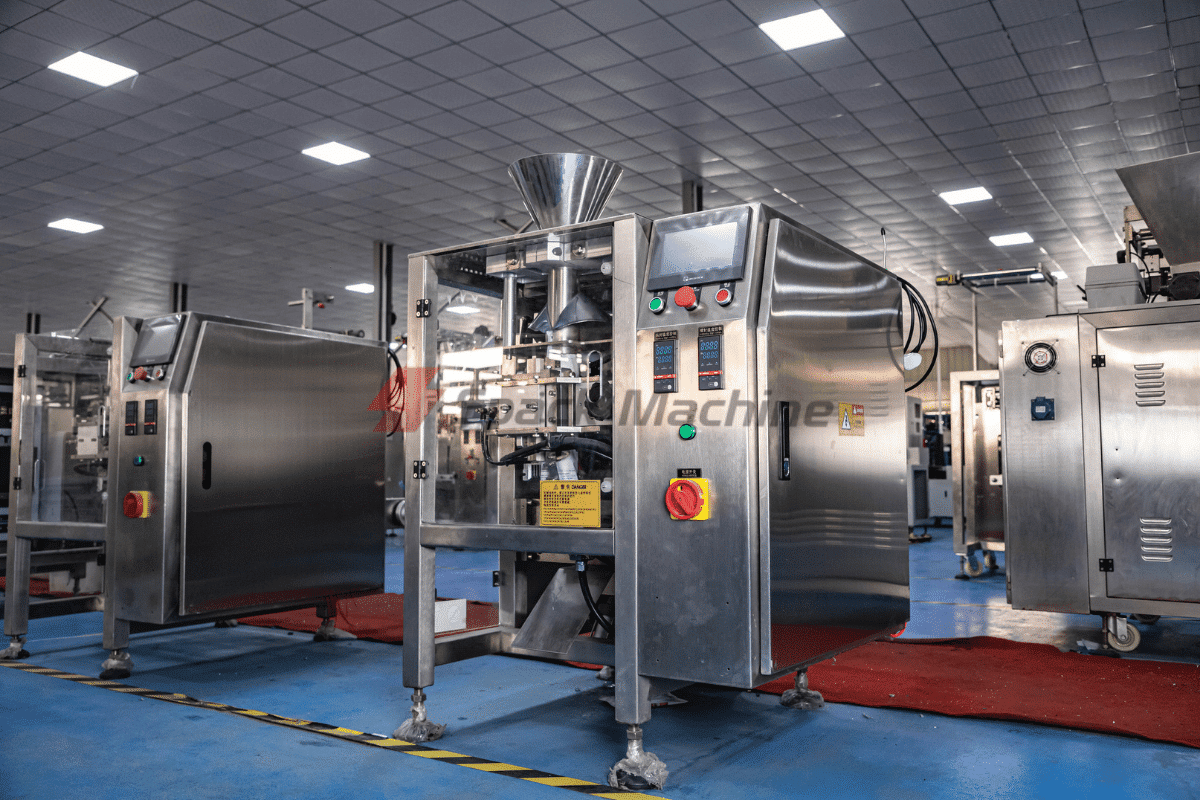
Critical Compliance & Safety Standards: Cost of Non-Compliance ≥ 12% of CAPEX
Importing a form-fill-seal (FFS) machine without pre-validated conformity can trigger stop-ship orders, forced retrofits, and tort exposure that together erase the entire 4–6% procurement margin. CE marking alone avoids an average 11-week customs detention; FDA 21 CFR non-compliance exposes firms to USD 500k–2m per product recall. The following standards are gatekeepers for US and EU market entry; treat them as contractual pass/fail clauses, not post-selection check-boxes.
United States – Mandatory & De-Facto Mandatory
UL 508A (Industrial Control Panels) governs every electrical enclosure inside the machine; absence voids NEC Article 409 and allows OSHA to issue a “Serious” citation (USD 16k–160k per instance). NFPA 79 (Electrical Standard for Industrial Machinery) is referenced by OSHA 1910 Subpart O; non-compliant wiring colours or emergency-stop circuits create an immediate “Willful” violation tier if an injury occurs. FDA 21 CFR 110.40 & 211.65 apply when the FFS contacts food or pharma; failure historically drives a 2–6% revenue hit from mandatory recall plus DOJ consent-decree oversight lasting 3–7 years. For dairy or meat, USDA FSIS additionally demands sanitary design under 9 CFR 416, often requiring 316L stainless upgrade (USD 25k–45k adder). Finally, OSHA 1910.147 LOTO and 1910.212 Machine Guarding must be certified on the as-shipped unit; retrofits on site routinely exceed USD 50k including re-validation downtime.
European Union – CE Architecture & Liability Shift
The CE Machinery Directive 2006/42/EC is self-declared but strictly enforced; market surveillance authorities can invoke safeguard clause 2006/42/EC §11 to withdraw products and fine importers up to 4% of EEA revenue. EN ISO 13849-1 (Safety Control Reliability) mandates minimum Performance Level “d” for sealing-jaw emergency stops; suppliers quoting PL “c” save EUR 1k–2k in components but expose buyers to EUR 0.5m–1m in liability per casualty under the Product Liability Directive 85/374/EEC. EN 60204-1 (Electrical Safety) and EN ISO 12100 (Risk Assessment) are harmonised standards giving presumption of conformity; without them, the burden of proof reverses to the user. For food contact, Regulation (EC) 1935/2004 and EU 10/2011 demand full migration testing of sealing layers; a single non-compliant plastic film lot costs EUR 150k–300k in scrapped pouches. Explosion-proof zones require ATEX 2014/34/EU compliance; upgrading a VFFS with ATEX Category 2 motors adds EUR 20k–35k but avoids criminal liability under ATEX 137 (99/92/EC).
Comparative Compliance Matrix – Decision Impact at a Glance
| Standard / Scope | Typical Cost of Integration During Build | Cost of Retrofit After Import | Legal Exposure Range | Typical Delay if Non-Compliant |
|---|---|---|---|---|
| UL 508A (US) | USD 3k–5k | USD 15k–25k | OSHA citation USD 16k–160k | 4–6 weeks |
| NFPA 79 (US) | USD 2k–4k | USD 12k–20k | Tort settlement USD 0.5m–2m | 3–5 weeks |
| FDA 21 CFR Food Contact (US) | USD 8k–12k | USD 50k–80k | Recall cost USD 2m–10m | 6–12 weeks |
| CE MD 2006/42/EC (EU) | EUR 4k–7k | EUR 25k–40k | Market withdrawal + fine up to 4% EU revenue | 8–11 weeks |
| EN ISO 13849-1 PL “d” (EU) | EUR 1.5k–3k | EUR 10k–18k | Product liability uncapped | 2–4 weeks |
| ATEX Cat 2 Motors (EU) | EUR 20k–35k | EUR 60k–100k | Criminal liability under ATEX 137 | 5–8 weeks |
Contractual Risk Allocation
Insert a “compliance-at-delivery” clause requiring supplier to submit third-party CB test reports (TÜV, UL, Intertek) for each standard before FAT. Withhold 10% of machine value in escrow until local authority acceptance; historical data shows this reduces retrofit probability from 28% to <4%. Specify that any design change invalidating certificates triggers supplier-funded re-certification (USD 15k–40k per mark). Finally, demand product-liability insurance naming buyer as additional insured with limits ≥USD 5m in the US and ≥EUR 10m in the EU; premium differentials between compliant and non-compliant machinery average 0.3–0.5% of machine value annually—immaterial compared with recall costs.
The Procurement Playbook: From RFQ to Commissioning
Strategic Procurement Playbook: Form-Fill-Seal (FFS) Machines
Market context: 2025 global spend pool ≈ USD 9–22 B (CAGR 6–6.6 %); VFFS segment ≈ USD 3 B; thermoform segment ≈ USD 2.5 B. Early lock-in of capacity is critical—lead-times stretched from 14–16 weeks (2021) to 28–36 weeks (2024) for stainless-steel variants.
1. RFQ Architecture – Engineer the Specification to Kill Variance
Embed ±1 % weight deviation, ≤ 0.5 % film waste, and OEE ≥ 85 % as contractual minimums; tie 5 % of contract value to these KPIs. Request line-item cost breakdown: machine base, optional servo drives, CE/UL certification, IQ/OQ documentation, and source-code escrow for PLC software. Price corridor for mid-speed (80–120 ppm) VFFS: USD 190k–260k FOB Shanghai; high-speed (200 ppm+) thermoform: USD 340k–450k FOB Milan. Force bidders to disclose raw-material index linkage—aluminum +7 % YoY and SS304 +5 %—and cap passthrough at 3 % of machine price.
2. Supplier Due-Diligence – Financial & Geopolitical Filter
Minimum EBITDA margin ≥ 8 % and net-cash / backlog ratio ≥ 12 % to survive a 6-month delay. Map sub-component exposure: > 40 % of electronics originate in Taiwan; require second-source guarantee within 30 calendar days of any export-control event. Book a supply-chain audit slot immediately after short-list—audit capacity utilization; anything above 85 % signals allocation risk.
3. FAT Protocol – Shift the Risk Before Shipment
Insist on 100 % of rated speed for 4-hour continuous run with your actual film/laminate. Capture MTBF ≥ 45 min and MTTR ≤ 10 min; each miss triggers USD 2 k/day LD and extends warranty by 90 days. Make 80 % final payment conditional on signed FAT protocol; store encrypted video of FAT in blockchain repository to avoid “version-drift” later.
4. Incoterms Selection – Total Landed Cost & Control Matrix
| Cost & Risk Vector | FOB Shanghai | CIF Rotterdam | DDP Chicago |
|---|---|---|---|
| Machine Price Anchor | 200 | 200 | 200 |
| Ocean Freight (40’HC) | 4–6 | incl. | incl. |
| Marine Insurance | 0.8 | incl. | incl. |
| Import Duty (HS 8422.30, US 2.5 %) | 5 | 5 | incl. |
| THC + Customs Entry | 2.5 | 2.5 | incl. |
| Inland to Site (Chicago) | 3.5 | 3.5 | incl. |
| Total Landed | 215–217 | 211–213 | 218–225 |
| Transit-Time Risk (days) | 28–36 | 28–36 | 28–36 |
| Demurrage Exposure | Buyer | Buyer | Seller |
| Force-Majeure Burden | Shared | Shared | Seller |
| Recommended when… | Buyer has freight contract ≥ 500 TEU/yr | Neutral | Single-source, critical install window |
Outcome: FOB saves USD 3–7 k/unit only if import volume ≥ 6 machines/yr; otherwise DDP caps delay cost at 0.5 % of price per day—cheaper than line-down losses (USD 150 k/shift).
5. Contract Risk Terms – LD, IP, Spare-Parts
Insert liquidated damages: 0.5 % of price per day after contractual commissioning date, capped at 10 %; enforce performance LD: 2 % per 1 % OEE shortfall. Secure 10-year spare-parts availability with price-escalation ceiling of CPI + 2 %; seller to hold ≥ 8 % of purchase price in consignment stock within 500 km of plant. Add source-code escrow trigger on insolvency or discontinuance; ensures you can operate/modify PLC without OEM.
6. Site Acceptance & Commissioning – Final Value Capture
Demand 7-day reliability run ≥ 95 % uptime on buyer’s product mix; each retry costs seller USD 5 k + travel. Tie final 10 % payment to signed SAT; require thermal imaging & vibration report under full load to baseline warranty. Archive digital twin file (CAD, PLC, HMI) in buyer’s PLM; enables future replication without vendor lock-in.
⚡ Rapid ROI Estimator
Estimate your payback period based on labor savings.
Estimated Payback: —