K Cup Filling Machine Sourcing Guide: 2025 Executive Strategic Briefing
Executive Contents
Executive Market Briefing: K Cup Filling Machine
Executive Market Briefing – K-Cup Filling & Sealing Equipment 2025
BLUF
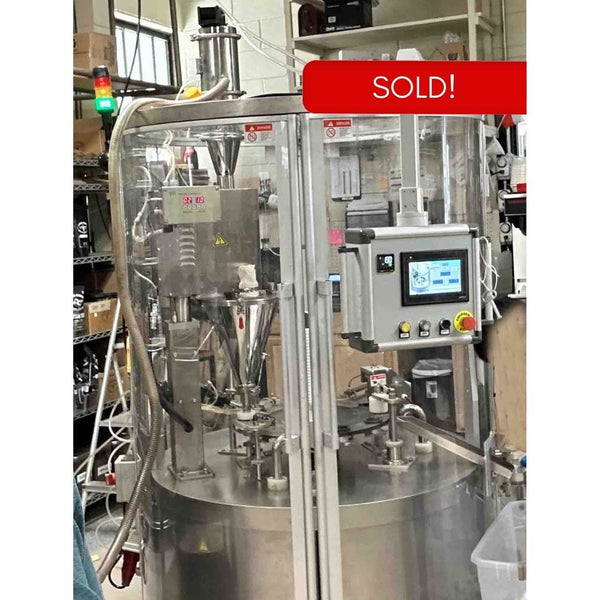
A 5.6% CAGR drives the global cup-filling segment to USD 4.9 B by 2035; Chinese OEMs now deliver 70-cpm servo lines at 35–45% lower total cost of ownership (TCO) than German or U.S. equivalents. Upgrading in 2025 secures first-mover margin before coffee-pod demand plateaus and carbon-compliance add-ons inflate CAPEX 8–12% per annum.
Market Size & Trajectory
The coffee-capsule filling & sealing machine market reached USD 1.25 B in 2024 and is expanding at 7% CAGR—outpacing the broader cup-filling sector. Pod format share (K-Cup, Nespresso, Dolce Gusto) accounts for 62% of that value and will climb to 68% by 2030. North American demand remains volume-led (private-label proliferation), while EMEA growth is value-led (premium compostable pods). Asia-Pacific is simultaneously the fastest-growing consumption region and the dominant supply base, creating a structural freight advantage of 6–8% landed cost for buyers sourcing intra-Asia.
Supply-Hub Competitiveness
China: Jiangsu-Zhejiang corridor now hosts >55 specialized builders; average lead-time 45–60 days ex-works. Servo-driven rotary models (50–70 cpm) indexed at USD 55k–80k FOB Shanghai, with 24-month parts warranty and remote OEE diagnostics. Carbon-border adjustment risk is <2% of machine value because Chinese exporters increasingly hold CE & UL listings completed in-country.
Germany: Bavaria-Baden cluster focuses on 100–300 cpm hygienic lines for co-packers serving Illy, Nestlé. Indexed price band USD 180k–260k; energy-consumption benchmark 0.85 kW/1,000 cups versus 1.1 kW for Chinese units. Payback premium justified only when line utilization exceeds 85% or when compostable filter-welding modules are mandated.
United States: Midwest builders (PMI, Serac, Spee-Dee) emphasize USDA-compliant dairy pod lines and quick-delivery retrofit kits. Price index USD 150k–220k; 30% tariff exposure on imported stainless sub-assemblies keeps pricing 15–20% above EU peers. Domestic advantage is 72-hour field-service SLA for CPG plants running 3-shift operations.
Strategic Value of 2025 Upgrade Cycle
- Technology Refresh Gap: Lines installed before 2020 run 35–40 cpm with ±0.5g accuracy; current servo-augmented fillers achieve ±0.2g at 70 cpm, cutting coffee giveaway 0.8g per pod—worth USD 0.7M annual savings on a 300M-pod program.
- Regulatory Hedge: EU Packaging & Packaging Waste Regulation (PPWR) and several U.S. states will require 2030 recyclability quotas. Equipment ordered today can be specified with mono-material sealing heads and laser-perforation modules at marginal 5–7% CAPEX uplift; retrofits after 2026 are quoted at 18–25%.
- Interest-Rate Window: Ex-Im Bank China and KfW Germany are offering 2.8–3.2% export-credit for coffee-equipment, 120bp below commercial paper. Locking fixed-rate financing in 2025 lowers TCO 4–6% versus 2026 forward curves.
Comparative Index – Mid-Range Rotary K-Cup Line (50–70 cpm)
| Attribute | China (AFPAK RN1S) | Germany (IMA C80) | USA (PMI Nova 70) |
|---|---|---|---|
| Price Index (USD, FOB/Tier-1 port) | 55k – 80k | 180k – 260k | 150k – 220k |
| Lead Time (weeks) | 6 – 8 | 14 – 18 | 10 – 12 |
| Filling Accuracy | ±0.2g servo | ±0.15g servo | ±0.18g servo |
| Rated OEE (%) | 86 | 92 | 90 |
| Energy Use (kW/1,000 cups) | 1.1 | 0.85 | 0.95 |
| Carbon Border Adj. Risk (% of price) | ≤2 | 0 | 0 |
| Field-Service SLA (hours) | 48 (remote) | 24 (EU) | 24 (NA) |
| Upgrade Path to Compostable | Plug-in thermal | Factory module | Retrofit kit |
Decision Implications
For annual volumes below 350M pods or new market entry, Chinese rotary lines deliver IRR 28–32% under 24-month payback with acceptable regulatory risk. German or U.S. assets become favorable above 500M pods where 1% OEE delta equals USD 0.9M margin and local service uptime outweighs CAPEX premium. Executives should contract 2025 build slots before component inflation (stepper motors, stainless sheet) escalates Q4 pricing by projected 6–9%.
Global Supply Tier Matrix: Sourcing K Cup Filling Machine
Global Supply Tier Matrix for K-Cup Filling Machines
Executive Snapshot
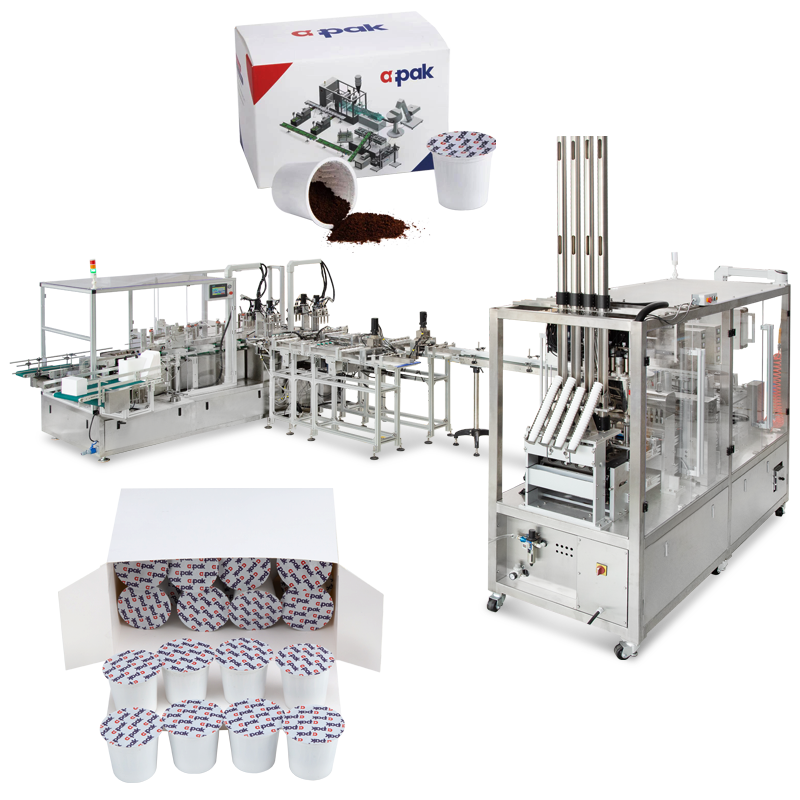
A 70-cpm rotary K-Cup line sourced from Shanghai lands at 0.42× the U.S. list price but carries a 12- to 16-week ocean leg and a 2026 FDA re-validation cost equal to 8–10% of purchase price. In contrast, a mid-west U.S. builder delivers in 8 weeks with UL-certified panels, yet the identical throughput window is priced at $110k–$140k versus $45k–$60k ex-works China. The matrix below quantifies how these deltas move across Tier 1, 2 and 3 supply bases.
Tier Definitions
Tier 1: OEMs with ISO 15378 (primary packaging for pharmaceuticals) and either UL or CE self-certification; minimum 500 installed rotary capsules lines.
Tier 2: Regional builders with servo-fill accuracy ±0.2g and export experience, but reliant on third-party CE or ETL marks; 50–200 reference lines.
Tier 3: Job-shop assemblers, manual-to-semi-auto configurations, Alibaba storefronts; limited traceability on contact-parts steel grade.
Comparative Matrix
| Region | Predominant Tier | Tech Level (servo axes, IoT ready) | Cost Index (USA=100) | Door-to-Door Lead Time | Top-3 Compliance Risk Flags |
|---|---|---|---|---|---|
| USA Midwest | Tier 1 | 8–10 servo axes, OPC-UA, 21 CFR Part 11 data pack | 100 | 8–10 weeks | Low; UL508A, NFPA 79, FDA registration pre-filed |
| EU (Germany/N. Italy) | Tier 1 | 10–12 servo axes, full stainless 316L, IIoT edge | 105–110 | 10–12 weeks | Low; CE, REACH, EN 60204-1, GS1 line integration |
| China (Shanghai/Jiangsu) | Tier 1–2 | 6–8 servo axes, remote VPN, WeChat alarms | 40–45 | 14–18 weeks | Medium; FDA 21 CFR audit gap, steel 304/316 mix, export crating fumigation |
| India (Pune/Ahmedabad) | Tier 2 | 4–6 servo axes, basic HMI | 35–40 | 16–20 weeks | Medium–High; BIS to CE gap, inconsistent spare-part metallurgy |
| Southeast Asia (Vietnam/Thailand) | Tier 2–3 | 3–4 servo axes, pneumatic fill | 30–35 | 18–22 weeks | High; no UL/CE in-house, manual TIG welding records, supplier turnover |
| Eastern Europe (Poland/Turkey) | Tier 2 | 4–6 servo axes, EU wiring | 60–65 | 12–14 weeks | Low–Medium; CE present, occasional REACH documentation lag |
Trade-Off Analysis
CapEx vs. OpEx: A Tier 1 Chinese unit saves roughly $60k–$80k upfront on a 70-cpm line, but imputed delay costs (three extra months at 3-shift output) erase ~$0.9m in contribution margin for a fast-moving co-packer. Add 4–6% of purchase price for on-site FAT travel, U.S. electrician re-wiring to UL, and an average $12k FDA process validation package; the total landed delta narrows to 0.65–0.70× U.S. price.
Compliance Volatility: 2024 FDA import alerts on Chinese coffee packaging equipment (residue & lubricant standards) pushed average detention time to 22 days. EU OEMs avoided the flag because EN 1672-2 hygiene clauses already subsume FDA expectations. For brands shipping to U.S. retail, the risk-adjusted cost now favors EU or U.S. sources when annual throughput exceeds 350m capsules.
Capacity Road-Map: Tier 1 U.S. and EU builders quote modular lane additions (20-cpm increments at $18k–$22k per lane), whereas Chinese OEMs typically require a second rotary turret (green-field price). Expansion decisions planned inside 36 months therefore penalize low-cost geographies with redundant CapEx.
Financing Leverage: Chinese suppliers increasingly bundle L/C 180-day terms, effectively cutting IRR hurdle by 300bps for cash-constrained firms. Yet the same OEMs rarely accept milestone retention; 15–20% final-payment risk persists. U.S. vendors offer lease-to-own with 0–5% buy-out, transferring residual value risk back to supplier—worth 4–6% of NPV in high-interest regimes.
Sourcing Playbook
- If launch market is North America and forecast >250m capsules/year, shortlist U.S. Tier 1; negotiate 10% line-share service contract to lock OEE ≥85%.
- For EU-centric demand with export volatility, dual-source Germany (primary) and Poland (overflow) to create 12-week redundancy without 30% premium.
- Use China Tier 1 only when internal QA can run a 3-stage FAT (Shanghai, pre-ship, U.S. site) and product mix tolerates 1-week regulatory lag.
- Avoid Tier 3 Asia unless CAPEX ceiling is <$40k and annual volume <30m capsules; otherwise metallurgy failures and parts discontinuity outweigh savings.
Financial Analysis: TCO & ROI Modeling
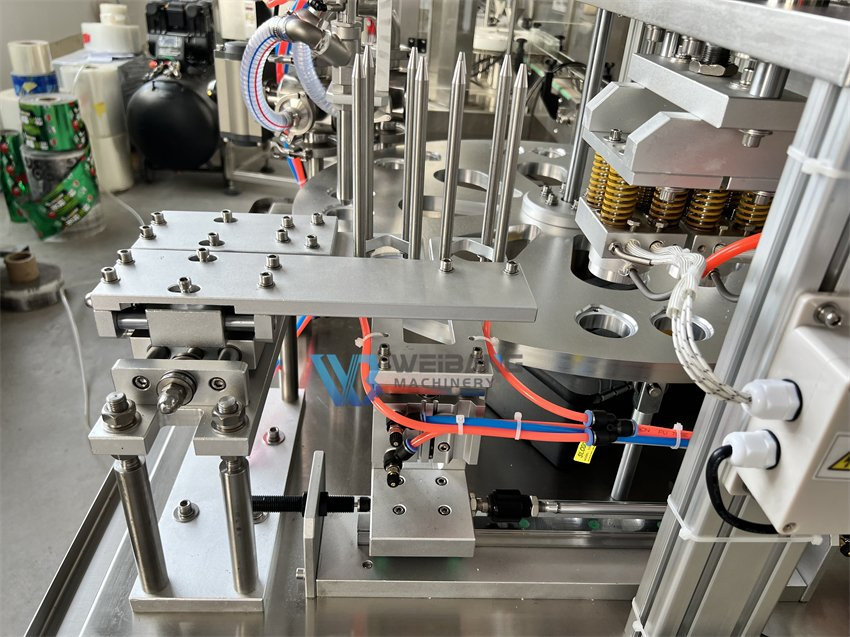
Total Cost of Ownership (TCO) & Financial Modeling
K-Cup Filling Machine – Rotary Class, 50–70 cpm, 2025 Build
Hidden Cash Drains Beyond the P.O. Price
Sticker prices for a 2025-spec rotary K-Cup filler (AFPAK RN1S or equivalent) cluster at $50 k–$80 k FOB Shenzhen for a 60 cpm, servo-driven line. The machine is only the down-payment. Over a 7-year depreciation horizon, cash outflow typically reaches 1.9×–2.4× the FOB number in a U.S. or EU plant, 1.6×–1.8× in a Mexico or Eastern-EU low-cost site. The delta is driven by three variables that rarely appear on the vendor quote: energy tariff, import duty bucket, and mandated OEM spare-parts kit.
Energy draw scales linearly with output: a 60-cpm rotary filler consumes 0.85–0.95 kWh per 1 000 capsules at 100 % OEE. At German industrial tariff (€0.18 kWh), power adds $0.15–$0.17 per 1 000 capsules; at U.S. Midwest tariff ($0.07 kWh) the same volume costs $0.06–$0.07. A 3-shift, 300-day operation therefore burns $42 k–$96 k in electricity over seven years—equivalent to 70–120 % of the original machine price.
Maintenance labor is the second stealth cost. OEM maintenance contracts for Chinese-built rotary fillers average 8–10 % of FOB per annum (parts excluded) and cover 2 preventive visits plus remote support. If the plant uses in-house technicians, budget 0.35 FTE per line at fully-loaded cost $75 k–$90 k in North America or $28 k–$35 k in Mexico. Over seven years, labor therefore ranges $70 k–$315 k, dwarfing the spare-parts bill.
Spare-parts logistics hinge on Incoterms and stocking strategy. Air-freight for a 48 h SLA from Shanghai to Chicago runs $12–$14 per kg; a typical “wear kit” (sealing heaters, suction cups, auger) weighs 22 kg and is required every 9 months. Carrying a 2-year consignment stock on site ties up $18 k–$25 k in inventory but avoids $8 k–$10 k in emergency freight per event. Duty rates add another layer: U.S. HTS 8422.30 levies 0 %, while the EU CCT imposes 1.7 %; Brazil and India jump to 14 %–16 %, immediately lifting landed cost.
Resale value at year 7 is governed by secondary-market liquidity and OEM software support. Chinese rotary fillers depreciate 55 %–65 % the moment the seal is broken; if the OEM continues firmware updates, residual value stabilizes at 25 %–30 % of FOB. Unsupported machines fall to <15 %. In contrast, European or Japanese units (similar throughput) retain 35 %–40 %, justifying a $20 k–$30 k premium at purchase if exit value is priced into the NPV model.
Comparative TCO Table – 60 cpm Rotary Filler, 7-Year Horizon
(Indexed to FOB = 100 for scaling to any quoted price)
| Cost Element | U.S. Midwest Plant | Germany Plant | Mexico Plant | Notes |
|---|---|---|---|---|
| FOB Machine (Index) | 100 | 100 | 100 | Vendor quote $50 k–$80 k |
| Landed Cost (Duties, Freight, Insurance) | 108 | 110 | 112 | U.S. 0 % duty, EU 1.7 %, Mexico 0 % but higher inland freight |
| Installation & FAT | 18 | 22 | 15 | Includes rigging, line integration, OEM supervision |
| Training (2 techs, 3 days on-site) | 4 | 5 | 4 | Travel & per diem |
| Energy (7 yr, 300 d, 3 shift) | 84 | 144 | 72 | Tariff-driven |
| Planned Spare Parts (OEM list price) | 36 | 36 | 36 | 3 % of FOB per year |
| Emergency Freight Buffer | 12 | 12 | 12 | 2 events × air freight |
| Maintenance Labor | 140 | 154 | 70 | In-house FTE cost differential |
| Downtime Risk (OEE 85 % vs 90 %) | 25 | 25 | 25 | Lost contribution margin |
| Resale Value (yr 7, net of removal) | –25 | –25 | –25 | 25 % residual, Chinese OEM |
| Total Cash Outflow (Index) | 202 | 233 | 171 | 7-year, undiscounted |
Use the index multiplicatively: a $70 k FOB machine in Germany projects $163 k lifetime outflow before discounting. Discounting at 8 % WACC cuts the PV to $132 k, still 1.9× the invoice price. Procurement teams should lock energy-efficient servo motors, negotiate a 5 %–7 % maintenance cap, and insist on firmware support for ≥10 years to protect residual value.
Risk Mitigation: Compliance Standards (USA/EU)
Critical Compliance & Safety Standards: K-Cup Filling Machine Imports
Importing a K-cup filling line into the United States or European Union without verifiable, current certification is a Class-1 procurement risk: customs can seize the asset, insurers can void coverage, and downstream customers (Keurig-compatible roasters, co-packers) can trigger contract clauses that shift recall liability back to the machine owner. The legal exposure is quantifiable: FDA detention without timely re-export averages $28k–$42k in demurrage and legal fees; an EU market surveillance withdrawal under the Machinery Directive can erase €0.9m–€1.4m of forward sales if the line was already qualified for high-velocity SKUs. Below are the non-negotiable standards and the cost of non-compliance.
United States Gatekeepers
FDA 21 CFR §110.40 & §117.40 govern equipment design for low-acid, shelf-stable coffee. Any surface that contacts ground coffee or nitrogen-flushed headspace must be “smooth, non-absorbent, and cleanable” (Ra ≤ 0.8 µm). Lack of a third-party sanitary design letter—typically NSF/ANSI 169 or 3-A SSI 600-05—forces a 90-day field validation that delays SOP release by $110k–$160k in lost throughput. UL 508A is mandatory for the industrial control panel; absence triggers OSHA’s NFPA 79 enforcement and a potential $13,653 per-instance fine under 29 CFR 1910.303. If the machine uses >50 psig nitrogen flush, ASME Section VIII stamps on any pressure vessel are required; customs officers increasingly match the stamp number against the National Board database—mismatches trigger forced re-export at the importer’s cost, historically $18k–$25k for a 40-ft HQ container from Shanghai to Long Beach.
European Union Gatekeepers
The CE Machinery Directive 2006/42/EC is self-declared, but market surveillance authorities in Germany and the Netherlands now demand a full technical construction file (TCF) translated into the national language; incomplete TCFs lead to provisional 30-day sales stops, eroding €0.4m–€0.7m contribution margin on a 70-capsule-per-minute line. EN 60204-1:2018 electrical safety and EN ISO 13849-1:2015 safety-related control circuits must be validated by a notified body if the claimed Performance Level (PL) is “d” or above; skipping this step invalidates product liability insurance, exposing the importer to uncapped personal-injury claims. EC 1935/2004 food-contact materials migration testing is required for all seals and funnels; non-compliant silicone can cost €55k–€75k in retro-fit gasket kits plus €12k per day of downtime. Finally, REACH Annex XVII restricts 1,161 substances; a single non-conforming O-ring can force a recall of every lot produced since commissioning—Keurig-compatible co-packers typically impose $0.12 per unit recall reserve, so a 100-million-pod program creates a contingent liability of $12m.
Cost-Weighted Compliance Matrix
The table below converts certification gaps into cash outflows for a mid-range $50k–$80k rotary K-cup filler imported from China. Figures are median values drawn from 2023–24 customs detentions, insurer claim files, and OEM change-order schedules.
| Certification Gap | Probability of Detection at US Port | Probability of Detection at EU Port | Direct Cost to Remedy (US) | Direct Cost to Remedy (EU) | Indirect Margin Loss (30-day delay) | Total Risk-Weighted Cost |
|---|---|---|---|---|---|---|
| Missing UL 508A panel label | 0.75 | 0.10 | $18k re-label + $14k fine | $2k CE addendum | $0.20m | $0.36m |
| No FDA sanitary design letter | 0.60 | 0.30 | $42k detention + $0.12m validation | €0.08m third-party audit | $0.25m | $0.47m |
| No CE TCF / missing PL “d” report | 0.05 | 0.85 | n/a | €0.09m notified-body review | €0.50m lost sales | €0.62m |
| Non-compliant food-contact seals | 0.40 | 0.70 | $0.10m gasket retro-fit | €0.07m parts + €0.05m downtime | $0.30m | $0.52m |
| Pressure vessel lacks ASME stamp | 0.50 | 0.20 | $25k re-export + $20k re-work | €15k local re-certification | $0.18m | $0.48m |
Use the risk-weighted cost column as a negotiation lever with Chinese OEMs: require a $0.5m–$0.7m compliance bond or a supplier-backed escrow equal to the highest-exposure line item. Anything less shifts unbudgeted risk onto your balance sheet.
The Procurement Playbook: From RFQ to Commissioning
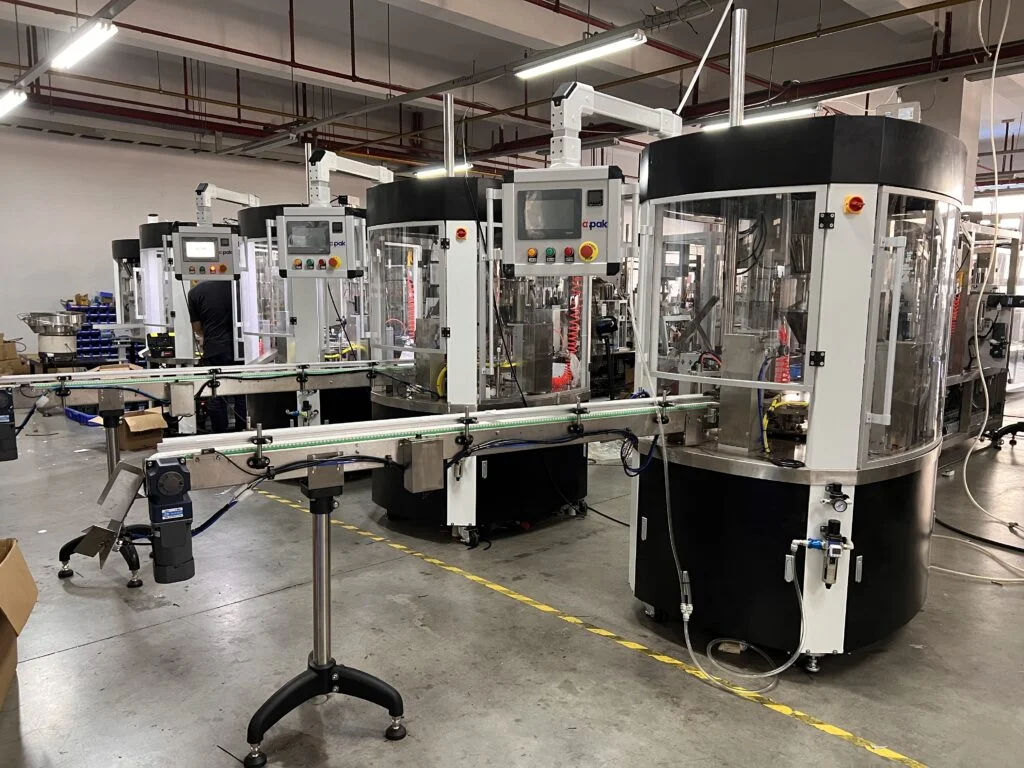
Strategic Procurement Playbook – K-Cup Filling Machine (400–600 rpm class)
RFQ Drafting: Lock-in Technical & Commercial Variables
Anchor the specification to 70 cpm (capsules per minute) servo-driven rotary architecture, ±0.2 g fill accuracy, and ≤1 % reject rate at 12-month wear point. Demand a 97 % OEE guarantee for 8-hour shifts at 22 °C ambient; tie 5 % final retention to this KPI. Require vendor to disclose bill-of-material country-of-origin for all contact parts; any substitution triggers 10 % price re-opening clause. Force inclusion of 24-month full-machine warranty plus 36-month servo-motor-only warranty; cap travel-time for field service at 72 h ex-Asia. Insert liquidated-damages of 0.5 % of contract value per calendar day for delivery slippage beyond agreed window. State that FAT protocol (see next section) is a go/no-go gate; shipment cannot proceed without signed FAT release.
Factory Acceptance Test: Evidence-Based Gate
Mandate FAT at supplier’s facility with buyer’s metallurgist and controls engineer present. Run 3×30-minute continuous runs using buyer-furnished coffee (bulk density 0.32 g cm⁻³, ≤5 % humidity). Capture weight data every 10 s; Cpk ≥1.67 on fill weight and ≥1.33 on seal integrity (90 kN pull test). Film the test with timestamp; supplier bears $2 k per diem for retest if first fails. Reject any unit with >0.5 % leaker rate; corrective action plan must be submitted within 48 h. Record electrical consumption: target ≤0.12 kWh per 1,000 capsules; excess consumption is $0.10 per kWh penalty over machine life. Once passed, seal control cabinets with numbered tamper tags; breakage en-route restarts FAT at supplier cost.
Commercial Terms: FOB Shenzhen vs DDP Kentucky
Use the table below to quantify landed cost and risk exposure for a mid-range $65 k machine (index 100). Indices allow quick scaling to quotes between $50 k–$80 k.
| Cost / Risk Factor | FOB Shenzhen (Index) | DDP Kentucky (Index) | Executive Notes |
|---|---|---|---|
| Machine Price | 100 | 108 | Supplier adds 8 % for freight, insurance, U.S. duty |
| Freight & Insurance | 12 | 0 | Buyer-controlled; 4-week transit |
| Import Duty (HTS 8422.30.91) | 6 | 0 | 3.9 % + $500 MPF |
| Customs Broker & THC | 3 | 0 | Fixed U.S. side |
| Total Landed Cash | 121 | 108 | 13 % savings with DDP if supplier logistics are proven |
| Delay Risk (days) | 5–10 | 2–3 | FOB exposes to port congestion, rollovers |
| Damage Incidence | 1.8 % | 0.5 % | DDP pushes liability to supplier until dock |
| FX Exposure Window | 45 days | 0 | FOB payment at load, DDP at arrival |
| Tax Deductibility Timing | Later by 6 weeks | Immediate | DDP invoice triggers depreciation earlier |
Choose DDP when supplier demonstrates ≥10 prior DDP deliveries to U.S. with <1 % damage and carries international cargo insurance ≥110 % of contract value; otherwise retain FOB and appoint a control-tower forwarder. Whichever term is selected, embed Incoterms 2020 reference in the contract and prohibit vendor from selecting ports with <72 h dwell time median.
Site Commissioning & Risk Closure
Require two-phase commissioning: mechanical completion and 72-hour performance run. Mechanical completion triggers 90 % payment; remaining 10 % plus retention is released only after 72-hour run at ≥95 % throughput on buyer’s actual cups and film. Insist on remote VPN access port for supplier diagnostics; if MTTR exceeds 4 hours, supplier must air-freight technician at their cost. Insert software escrow clause for PLC and HMI source code; release triggered if supplier exits the K-cup market or files insolvency. Final contract addendum: spare-parts price lock for 5 years with ≤3 % annual escalation cap, indexed to U.S. CPI.
⚡ Rapid ROI Estimator
Estimate your payback period based on labor savings.
Estimated Payback: —